

Content
- 1 Core Conclusion: Fiber Opener Selection Depends on Fiber Physical Properties
- 2 Matching Fiber Types with Opening Intensity
- 3 Technical Differences and Application Scenarios of Key Equipment
- 4 Practical Framework for Selection Decisions
- 5 Common Selection Mistakes and Avoidance Recommendations
- 6 Impact of Equipment Maintenance on Opening Quality
- 7 Equipment Configuration Examples for Different Production Lines
- 8 Summary
Core Conclusion: Fiber Opener Selection Depends on Fiber Physical Properties
The selection of a fiber opening machine fundamentally depends on the physical characteristics of the raw material. Polyester fibers suit standard-intensity pre-opening machines; natural fibers like wool require fine openers to prevent fiber damage; while coarse fibers such as jute demand reinforced opening systems equipped with metallic card clothing. The core principle is to match fiber length, fineness, and surface friction coefficient with the carding intensity of the equipment.
Matching Fiber Types with Opening Intensity
The physical properties of fibers directly determine the opening process parameters. The following table presents common fiber types and recommended equipment configurations:
| Fiber Type | Fiber Characteristics | Recommended Equipment | Key Parameters |
| Polyester (PET) | High strength, good resilience, uniform length | Pre Opener + Fine Opener | Speed 800-1200 rpm, output 800-1200 kg/h |
| Wool Fiber | Scaly surface structure, prone to felting, variable length | Low-speed Fine Opener | Speed controlled at 400-600 rpm to avoid fiber breakage |
| Jute / Sisal | Coarse, high stiffness, contains lignin | Reinforced Pre Opener (metallic card clothing) | Equipped with metal detector to prevent impurity damage |
| Viscose Fiber | Low wet strength, smooth surface, prone to tangling | Pneumatic conveying type opener | Humidity controlled at 60%-65% RH to reduce static |
| Recycled Fiber | Variable length, contains impurities, uneven strength | Large Capacity Blending Bin + Pre Opener combination | Equipped with automatic impurity removal, output 400-600 kg/h |
Technical Differences and Application Scenarios of Key Equipment
Bale Opener (Preliminary Opening)
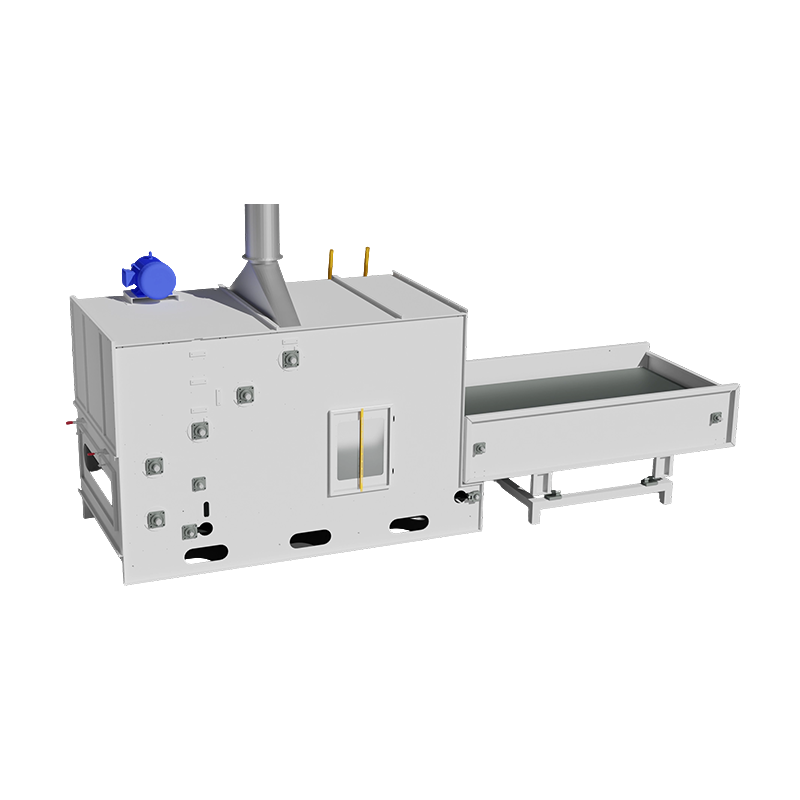
The bale opener uses a high-speed rotating spiked lattice to pluck small tufts from fiber bales, converting compressed fiber blocks into loose fiber tufts. This equipment is widely used in needle punched geotextile production lines and nonwoven carpet production lines for handling large volumes of raw material. Its standard configuration achieves an output of 800 to 1200 kg per hour, forming the capacity foundation of the entire nonwoven production line.
For synthetic materials such as polyester fibers, the bale opener spike density is typically 15 to 20 pins per square centimeter, with rotational speed set at 800 to 1000 rpm for effective opening. For coarse fibers like jute, metallic card clothing must replace the spike lattice, with speed increased to 1200 rpm to overcome the high stiffness resistance of the fibers.
Fine Opener (Precision Separation)
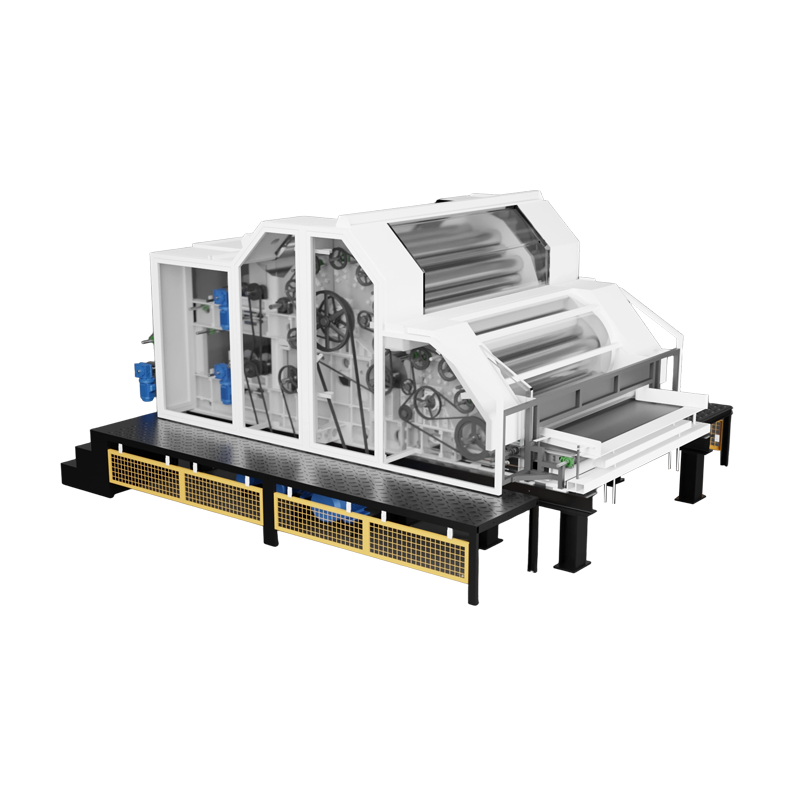
The fine opener is equipped with a cylinder covered in metallic card clothing or fine pins. Through centrifugal force and combing action, it further separates fiber tufts into a single-fiber state. This equipment is critical for automotive interior materials where high surface uniformity and zero-clump requirements are mandatory.
Fine opening of wool fibers requires special attention: due to the scaly surface structure of wool, high-speed friction causes felting. Therefore, the fine opener speed should be controlled at 400 to 600 rpm, with blunt-angle card clothing to reduce fiber damage. Practice shows that for every 100 rpm reduction in speed, the average length retention rate of wool fibers improves by approximately 8% to 12%.
Large Capacity Blending Bin
The large capacity blending bin adopts the "horizontal laying and vertical cross-section stripping" method. Fibers are layered in the bin and then stripped by a vertical lattice, ensuring an even mix of different fiber types. This equipment is the core unit for achieving precise ratios of natural and synthetic fibers in wool felt or jute felt production lines.
The blending bin capacity can be customized according to production requirements, with standard configurations handling mixtures of 2 to 6 different fiber types. For recycled fiber production lines, an automatic weighing system is recommended to control blending accuracy within plus or minus 1.5%, ensuring the mechanical performance stability of the final product.
Practical Framework for Selection Decisions
When selecting a fiber opening machine, evaluate according to the following priority sequence:
Step One: Define Fiber Physical Parameters
Measure the average fiber length, fineness (denier value), breaking strength, and surface friction coefficient. For example, polyester fiber denier values typically range from 1.5 to 6.0, while wool fiber fineness is measured in microns, ranging from 15 to 40 microns.
Step Two: Determine Opening Intensity Level
Select opening intensity based on fiber brittleness and damage sensitivity. Brittle fibers (such as viscose) suit low-intensity pneumatic opening; tough fibers (such as polyester) suit medium-intensity mechanical opening; high-stiffness fibers (such as jute) suit high-intensity metallic card clothing opening.
Step Three: Match Capacity with Equipment Configuration
The bale opener determines the upper capacity limit of the entire production line. If the target output is 1000 kg per hour, the rated capacity of the bale opener should be no less than 1200 kg/hour, reserving 10% to 20% safety margin.
Step Four: Evaluate Downstream Process Compatibility
Fibers after opening must directly enter the carding process. Therefore, the discharge uniformity of the opener directly affects the web quality of the carding machine. It is recommended to select an opening system equipped with an automatic leveling device, controlling discharge weight fluctuation within plus or minus 3%.
Common Selection Mistakes and Avoidance Recommendations
| Common Mistake | Correct Approach | Reference Standard |
| Ignoring fiber moisture content | Pre-condition viscose fibers to standard regain before opening | Viscose standard regain 13%, polyester 0.4% |
| Using uniform speed for all fibers | Wool fine opening speed should be 30%-50% lower than synthetic fibers | Wool 400-600 rpm, polyester 800-1000 rpm |
| Neglecting impurity pre-treatment | Recycled fibers require pre-positioned impurity removal and metal detection | Metal detector sensitivity must reach 2mm diameter |
| Setting blending ratios by experience | Use automatic weighing system for precise ratio control | Blending accuracy plus or minus 1.5% |
Impact of Equipment Maintenance on Opening Quality
The maintenance condition of opening equipment directly affects fiber processing quality. The following are key maintenance checkpoints:
Daily Maintenance: Remove fiber dust from spiked rollers and ventilation ducts to prevent fire hazards and maintain airflow efficiency. For every 10% increase in dust accumulation, equipment energy consumption rises by approximately 5%.
Monthly Inspection: Check card clothing wear condition. Blunted opening elements cause fiber tangling rather than separation, increasing clumping rate by 15% to 20%. It is recommended to replace card clothing after processing 500 tons of fiber.
Every 100 Operating Hours: Lubricate bearings and drive chains. Unstable transmission systems directly reflect in discharge uniformity, causing increased weight fluctuation in subsequent carding processes.
Sensor Calibration: Regularly test automatic control systems and metal detector sensitivity. Reduced metal detector sensitivity increases equipment downtime risk. Standard piece testing is recommended quarterly.
Equipment Configuration Examples for Different Production Lines
The following presents three typical nonwoven production line opening equipment configuration schemes:
| Production Line Type | Raw Material Composition | Opening Equipment Configuration | Expected Capacity |
| Needle Punched Felt Line | Polyester 80% + Low-melt fiber 20% | Bale Opener + Blending Bin + Fine Opener | 800-1000 kg/h |
| Automotive Interior Line | Polyester 60% + Wool 30% + Viscose 10% | Bale Opener + Blending Bin + Low-speed Fine Opener | 400-600 kg/h |
| Recycled Fiber Felt Line | Mixed recycled fibers | Bale Opener (impurity removal type) + Blending Bin + Fine Opener | 300-500 kg/h |
Summary
Fiber opener selection is essentially a systems engineering problem that requires comprehensive consideration of fiber physical properties, production line capacity targets, and downstream process quality requirements. Polyester fibers suit standard pre-opening and fine-opening combinations; natural fibers like wool require low-speed fine openers to protect fiber length; coarse fibers like jute need reinforced pre-opening equipment; recycled fibers require complete impurity removal and automatic ratio systems.
Correct selection not only improves fiber opening quality but also reduces energy consumption by 15% to 20%, extends card clothing service life by over 30%, and reduces fault downtime in subsequent carding processes. It is recommended to conduct small-batch trial production before final selection to verify equipment configuration compatibility with actual fiber characteristics.