

Content
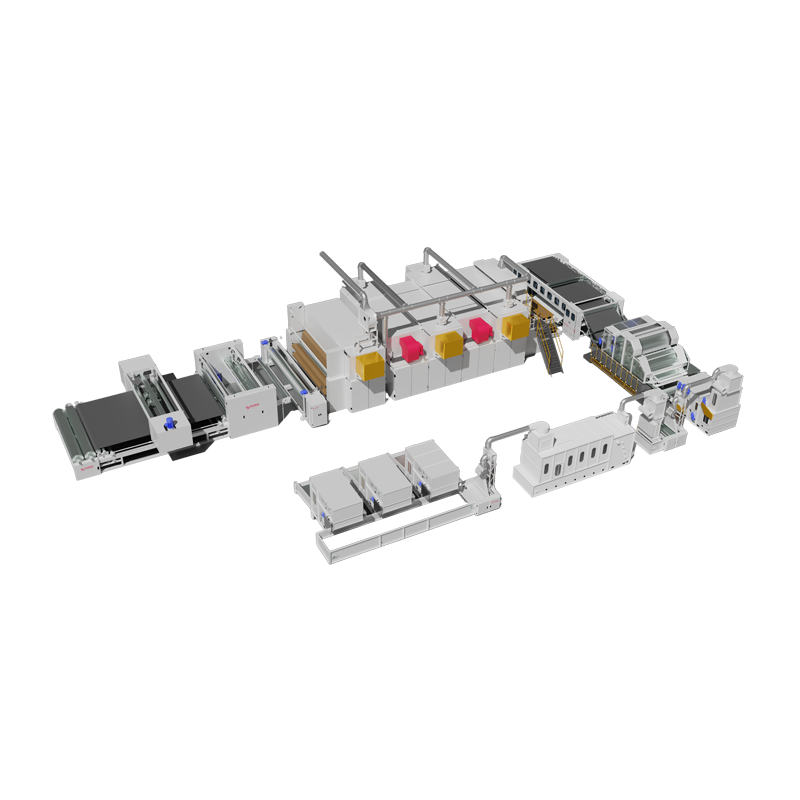
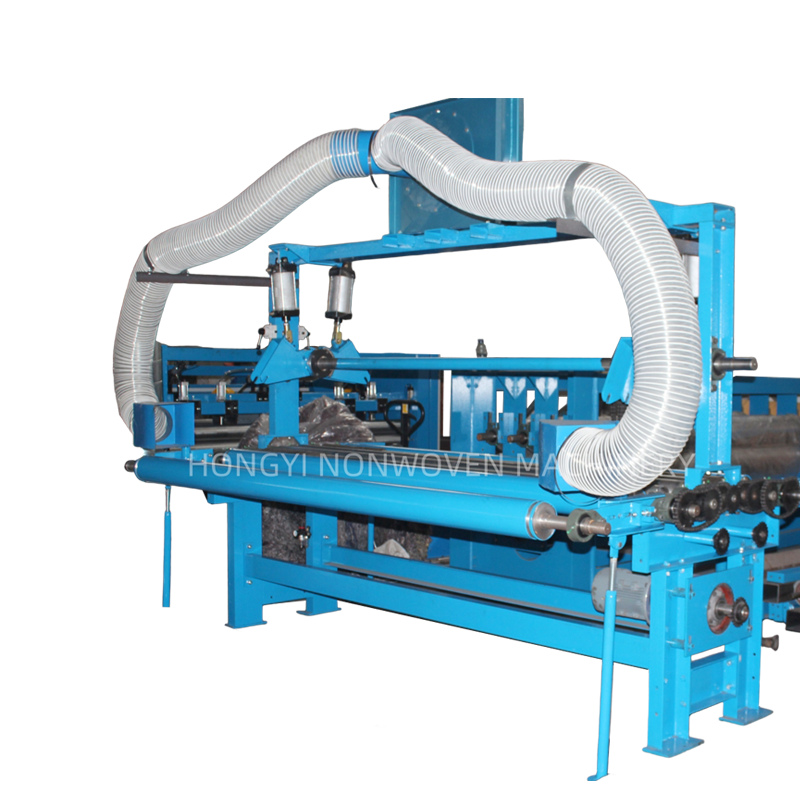
Nonwoven Thermal Bonded & Heat Setting Equipment works by applying hot air, heated rollers, or radiant heat to a fiber web so that low-melting fibers (such as ES sheath-core fiber or low-melt PET/PP blends) soften and fuse together, then cool and set into a stable structure. The result is a nonwoven fabric or thermal bonded wadding with controlled thickness, resilience, and dimensional stability. A standard line includes a nonwoven fabric oven, a multi-roller nonwoven fabric ironing machine, and a cooling/setting section, forming the core mid-stage process of any thermal bonded wadding production line or needle punching nonwoven line.
Equipment Structure and Core Function
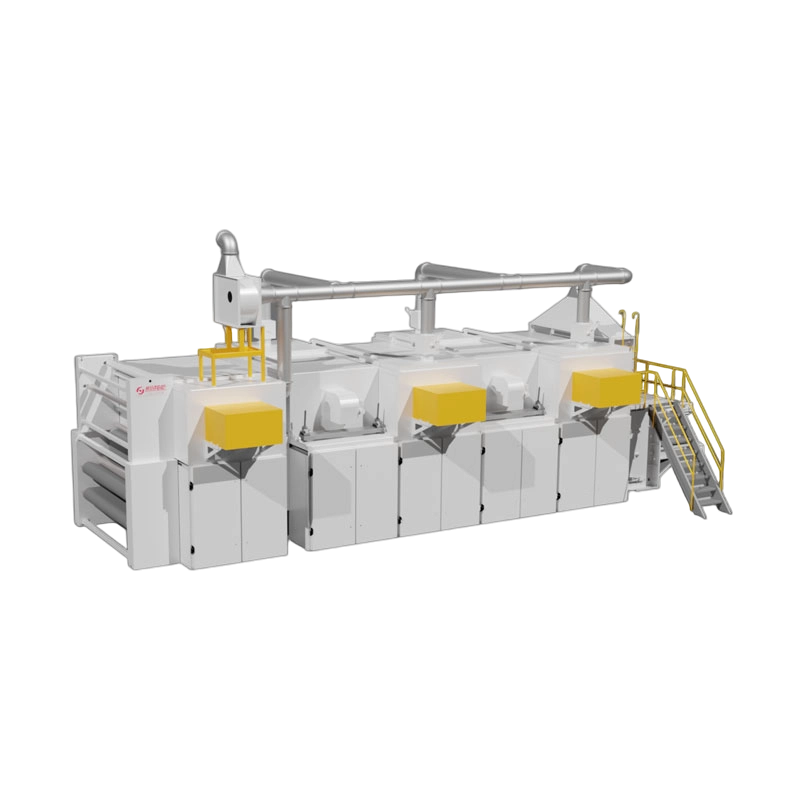
A complete thermal bonded and heat setting line is generally divided into three zones: preheating, main bonding, and cooling/setting. The preheating zone uses a circulating hot-air oven to bring the web up to temperature evenly, preventing surface fibers from melting too quickly and forming a hard skin while the core remains loose. The main bonding zone is the heart of the process and can be either a through-air oven for soft, bulky products or a calendering/ironing unit for denser, smoother products. The cooling/setting zone then quickly solidifies the bonded fibers using ambient rollers or air cooling, locking in thickness and preventing shrinkage.
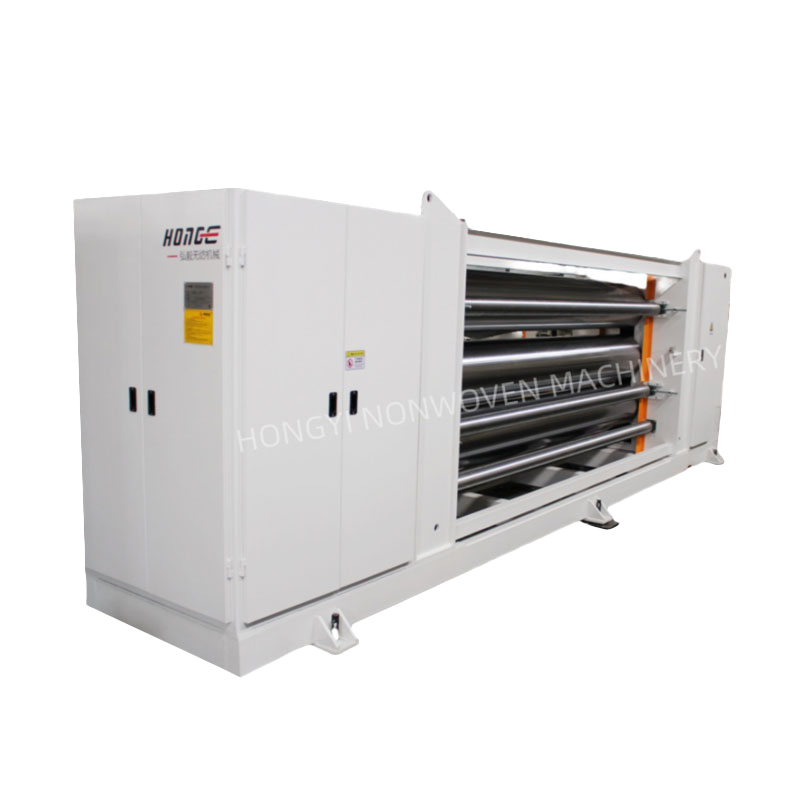
On a typical 2.5-meter-wide thermal bonded wadding line, the nonwoven fabric oven section usually runs 8 to 15 meters in length, divided into 2 to 4 independently controlled zones, with temperatures adjustable between 80 and 220 degrees Celsius depending on fiber composition. The downstream ironing machine is commonly a three-roller design with roller diameters around 300 to 400 mm and surface temperatures up to 160 to 220 degrees Celsius, allowing operators to fine-tune thickness, density, and surface finish through pressure and speed adjustment.
How It Works: Through-Air vs Roller Calendering
There are three common heat treatment approaches used in nonwoven thermal bonded and heat setting equipment, each suited to a different product profile. The comparison below helps narrow down the right configuration before contacting a supplier.
| Process Type | How It Works | Typical Products | Result Characteristics |
| Through-air bonding | Hot air passes vertically through the web, melting low-melt fibers evenly across the thickness | Bulky thermal bonded wadding, insulation batts, automotive sound-deadening pads | Soft, lofty, good resilience, larger thickness |
| Roller calendering / ironing | The web passes between heated rollers under pressure, compressing and setting the surface | Hard wadding panels, mattress core layers, filtration substrates | Flat surface, uniform density, dimensionally stable |
| Radiant heat bonding | Infrared heat radiates directly onto the web surface and conducts inward | Thin powder-bonded products, lightweight padding | Lower energy use, good for thin profiles |
In practice, many production lines combine both approaches: the nonwoven fabric oven first achieves uniform internal fiber bonding through hot air penetration, then the nonwoven fabric ironing machine flattens and finishes the surface. This sequence preserves internal loft while delivering a smooth, presentable surface, which is one of the most common configurations on modern thermal bonded wadding production lines.
Key Technical Parameters and Selection Reference
When evaluating thermal bonded and heat setting equipment, working width, temperature control accuracy, heating method, and line speed are the parameters that most directly affect real-world output. The ranges below reflect commonly seen configurations.
| Parameter | Common Range | Notes |
| Working width | 1.6 m - 3.6 m | Should match the width of the upstream carding machine and cross lapper to avoid edge waste |
| Oven temperature range | 80 - 220 degrees Celsius | At least 3 independently controlled zones recommended |
| Heating method | Electric, thermal oil circulation, gas/diesel burner | Electric heating reacts faster; thermal oil is more energy-efficient depending on local energy costs |
| Line speed | 3 - 30 m/min | Higher speeds require stronger hot-air circulation and cooling capacity |
| Ironing roller temperature | 160 - 220 degrees Celsius | Affects surface smoothness and density |
| Typical output | 300 - 1500 kg/h | Depends on basis weight, width and line speed combined |
Position Within a Full Nonwoven Production Line
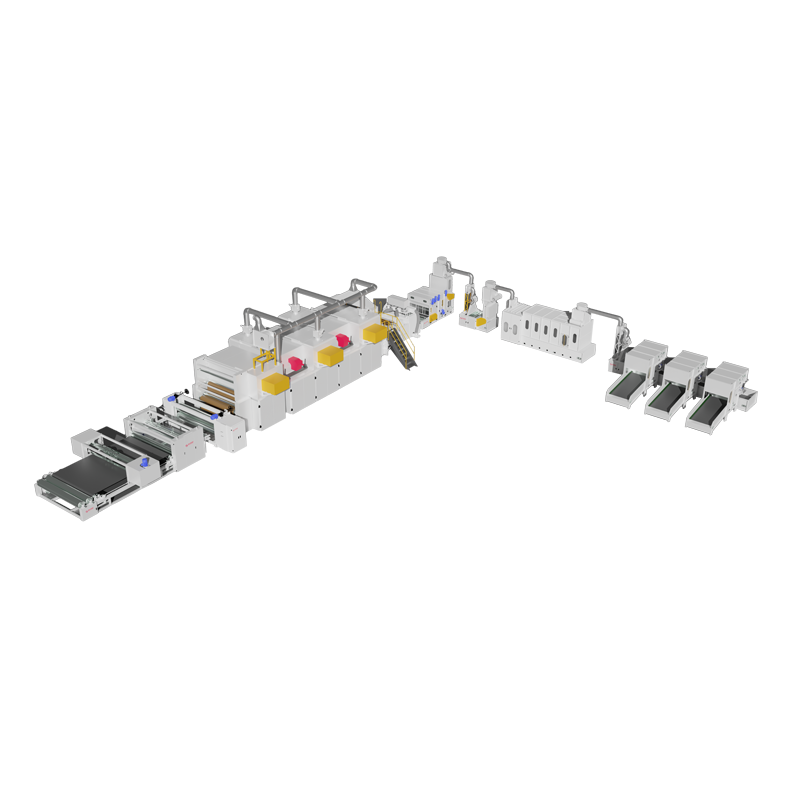
Thermal bonded and heat setting equipment rarely operates alone; it sits in the middle-to-late stage of a complete nonwoven production line. A typical thermal bonded wadding production line runs as follows: bale opener and fiber opening and blending equipment, then a nonwoven vibrating feeder or nonwoven pneumatic feeder, then a nonwoven carding machine, then a cross lapper machine, then the thermal bonded and heat setting equipment (oven plus ironing machine), and finally a nonwoven fabric slitting and winding machine. For products requiring higher mechanical strength, a needle punching machine is added between the cross lapper and the heat setting stage, combining needling with thermal bonding - a common configuration for automotive interior felts and industrial filter media.
Web tension uniformity also has a direct impact on heat setting quality, so many lines add a fiber web drafting machine and a web accumulator system before the oven, buffering and stretching the web to reduce thickness variation caused by speed fluctuations. An edge trim opener or preedge cutting device is often used to recover and recycle trimmed fiber, reducing raw material loss. For airlaid production lines, the same heat setting equipment applies, paired with an airlaid felt machine and an airlay winding and cutting machine to produce lightweight thermal bonded materials for hygiene products and medical applications.
Typical Application Areas
| Application | Example Products | Core Equipment Requirement |
| Mattress and furniture | Mattress core wadding, sofa filling padding | Even thickness, good loft and resilience, smooth surface |
| Automotive interiors | Headliner padding, sound insulation pads, carpet backing | Heat resistance and dimensional stability, compatible with needle punching |
| Insulation materials | Building insulation batts, pipe wrap materials | Low density, high loft, resistant to collapse |
| Filtration and medical | Air filter media, mask inner layers, medical substrates | Even basis weight, controllable pore structure |
| Acoustic materials | PET acoustic panels, sound-absorbing wadding | Flat surface for secondary molding |
These applications show that thermal bonded and heat setting equipment does more than just dry or flatten the web - it determines the final thickness tolerance, density distribution, and surface texture, which are often the first things customers notice during quality checks.
Choosing a Reliable Nonwoven Machinery Supplier
Because thermal bonded and heat setting equipment must run in sync with the carding machine, cross lapper, and needle punching machine, choosing a nonwoven machinery factory that can supply both standalone units and full production line solutions reduces commissioning time and integration issues significantly. When evaluating a nonwoven equipment supplier, a few points deserve close attention.
First, check whether the manufacturer offers a customized nonwoven machine solution based on your raw material (polyester, ES fiber, recycled fiber, etc.), target basis weight, and end-use, rather than only selling fixed standard units. Second, confirm whether the equipment is CE certified nonwoven machinery, which matters for export-oriented buyers and ongoing compliance in overseas markets. Third, look at the manufacturer's production capability and delivery track record as a nonwoven machine manufacturer - whether they have sufficient in-house processing equipment, provide installation and after-sales support, and have actual delivery cases of similar products such as thermal bonded wadding production lines, airlaid felt machines, or needle punching felt production lines.
Finally, before placing an order, define your target output, working width, and available energy sources (electricity, gas, or thermal oil), and ask the supplier to provide a specific configuration for oven zoning, heating power, and speed matching - not just a generic equipment list. This is the only way to ensure the thermal bonded and heat setting equipment is truly matched to the throughput of the upstream and downstream machines on the nonwoven production line.
Frequently Asked Questions
| Can the oven and ironing machine be purchased separately | Yes, but sourcing the full set from one nonwoven equipment supplier ensures consistent zone settings, speed synchronization, and tension control, avoiding integration issues later. |
| What fiber types work with thermal bonded equipment | Fibers containing a low-melt component, such as ES sheath-core fiber, low-melt PET, or PP/PE bicomponent fiber, blended with regular fibers as needed. |
| Is energy consumption high, and how can it be reduced | Most energy use comes from oven heating; thermal oil heating combined with strong insulation can reduce per-unit energy use while maintaining temperature accuracy. |
| Can this equipment be used on airlaid lines | Yes, airlaid production lines also require a heat setting stage; only the upstream web-forming method differs, while the heat setting structure can largely be reused. |