

Content
- 1 Why fiber mixing decides nonwoven quality
- 2 Mixing and blending: two terms, one goal
- 3 How fiber mixing works in a typical nonwoven line
- 4 Can you prove the mix is good enough?
- 5 Why mixing still fails in production
- 6 What to check before you buy mixing equipment
- 7 Frequently asked questions about fiber mixing
A needle-punched geotextile line in a mid-sized mill started producing rolls with light and dark stripes after a routine maintenance stop. The recipe was unchanged, card settings were untouched, and the needle loom showed no faults. The plant manager first suspected the card, but the real fault was 20 meters upstream: the blending chamber was being emptied faster than its layering cycle, so the web was being fed by fresh, poorly averaged fiber. It took a full shift and three downgraded rolls to restore normal output.
Fiber mixing does not show up on the finished fabric as a single defect. It shows up as vague streaks, borderline tensile tests, shade differences, and unpredictable consumption of expensive bonding fibers. The solution starts with understanding how mixing works, how to measure it, and which equipment choices actually improve it. That is exactly what this guide covers, with practical checks you can use on your own line.
Why fiber mixing decides nonwoven quality
The uniformity of the fiber mix entering the card is the strongest predictor of the uniformity of the fabric leaving the winder. Everything that happens later, carding, lapping, needling, or thermal bonding, can only rearrange the fibers it receives; none of these steps can correct a wrong proportion.
Three consequences of poor mixing show up directly in the final fabric:
- Color consistency. In colored nonwovens, pigment-carrying fibers often make up only 2 to 5 percent of the blend. A shift of one percentage point is enough to create a visible shade difference between rolls, especially in light and pastel colors.
- Bonding quality. In thermal-bonded wadding, low-melt polyester fiber must reach every part of the web in the same proportion. Local overdosing creates hard, glossy spots; local underdosing leaves areas that collapse during heat treatment.
- Mechanical uniformity. Tensile strength, elongation, and surface density all follow the blend ratio. When the mix CV drifts, test results become difficult to defend to the customer.
This is why experienced line managers watch blend ratio variation at the start of the line, not only the fabric at the winder. A simple way to visualize the effect of each process stage is to track the blend ratio deviation from target; the chart below shows an illustrative example based on typical mill practice.
Figure 1. How blend ratio deviation narrows through the line (illustrative example; lower is more accurate)
Mixing and blending: two terms, one goal
In textile terminology, mixing usually means combining fibers of the same type but different grades, for example two polyester staples of different denier, or two production lots of the same raw material. Blending means combining different fiber types, such as polyester with viscose, or polypropylene with low-melt bonding fiber. In a nonwoven plant, the line does both, often in the same equipment train.
The distinction is not academic. It affects how you set up the bale laydown, which metering devices you need, and what level of repeatability you request from the machinery supplier. If your product has to meet a strict low-melt fiber content, for instance, the blending accuracy requirement will be much tighter than if you only need to average out two grades of the same polymer.
If the machinery behind this step is new to you, this overview of how a fiber blending machine works explains the equipment sequence in plain language.
How fiber mixing works in a typical nonwoven line
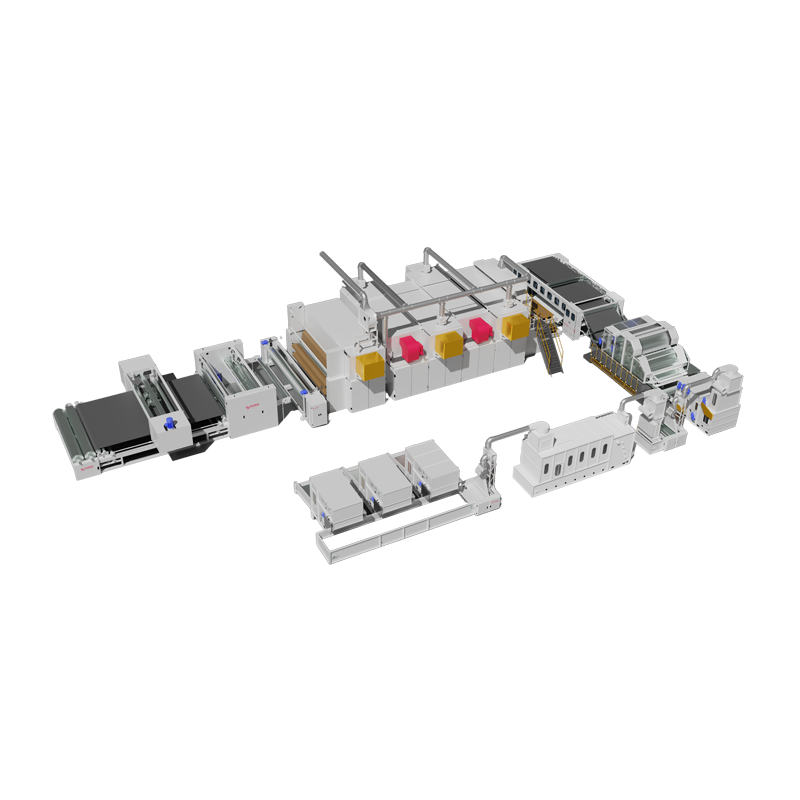
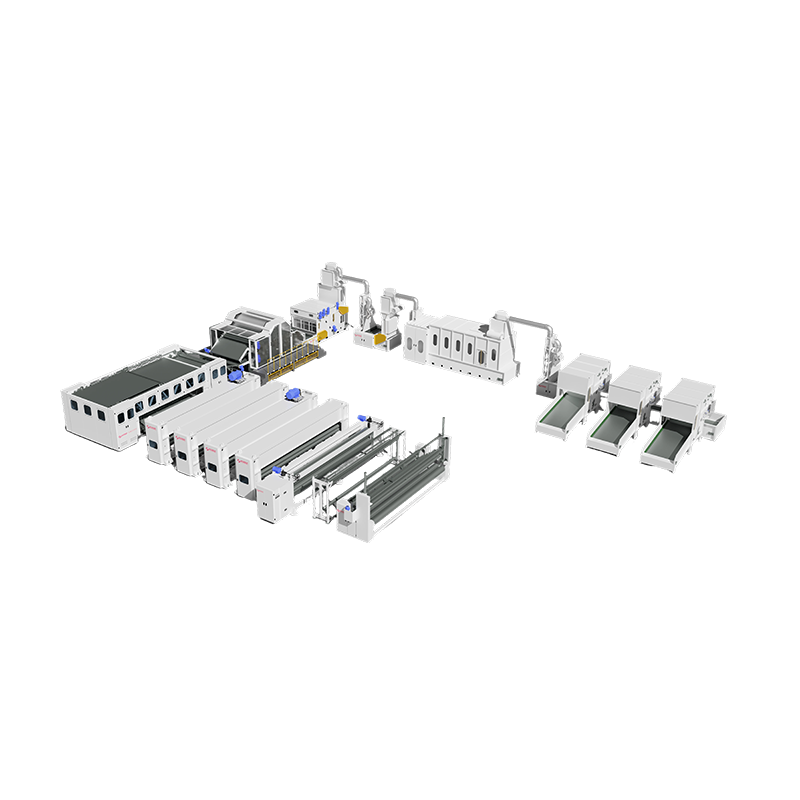
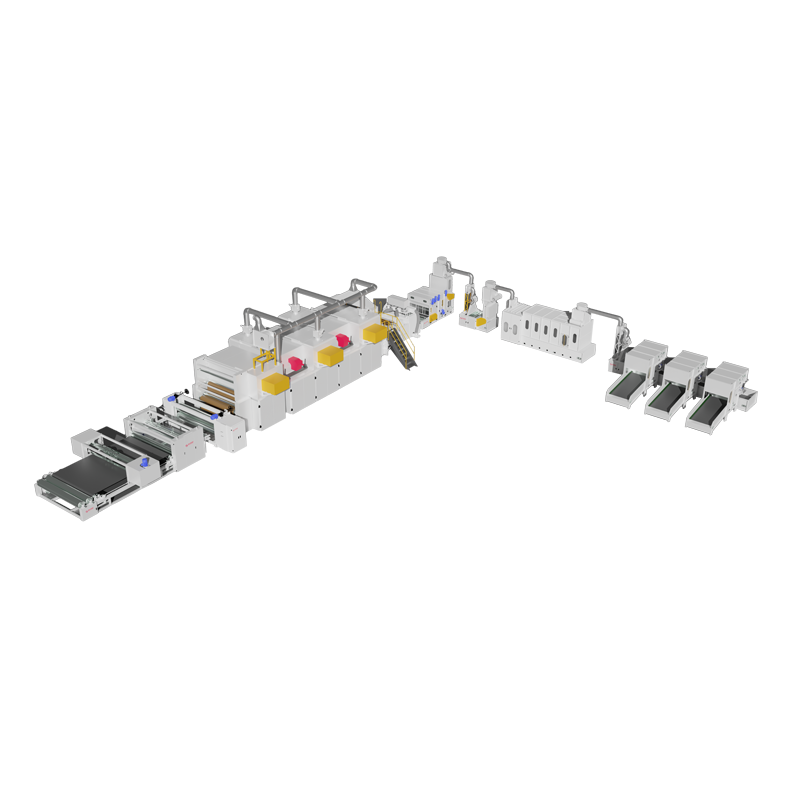
Fiber mixing starts at the bale and ends at the card feed. Five stages are involved, and each one has a measurable effect on final uniformity. The sequence below is typical for staple-fiber lines producing needle-punched felt, thermal-bonded wadding, or airlaid products.
| Stage | What happens in this stage | Main effect on mixing quality |
|---|---|---|
| Bale opening | Compressed bales are broken into loose tufts without excessive fiber damage. | Consistent tuft size prevents large clumps from entering the next stages. |
| Pre-fine opening | Tufts are reduced further and heavy impurities can be separated. | Smaller tufts allow more precise metering and faster blending. |
| Weighing and metering | Each component is fed at a controlled rate by a weighing belt or weigh pan. | Blend ratio accuracy depends almost entirely on this stage. |
| Blending chamber | Layered fiber is stored and withdrawn vertically to average out short-term variation. | Averaging time smooths fluctuations from the opening line. |
| Conveying and feeding | Opened and blended fiber is transported to the card or web former at a stable density. | Stable feed density protects the card from surge and starvation. |
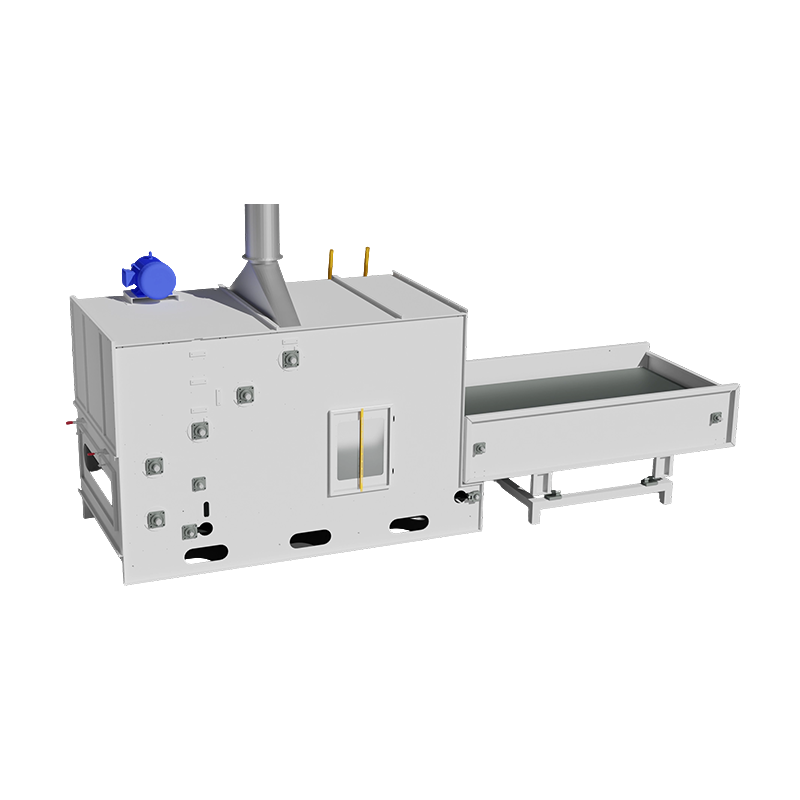
At the fine-opening stage, the degree of opening directly sets the limit of what the blender can achieve. A HYKS pre-fine opener is preferred when the bale opener alone leaves tufts that are still several grams in weight; on modern lines, reducing tuft size at this point is one of the cheapest quality upgrades you can make.
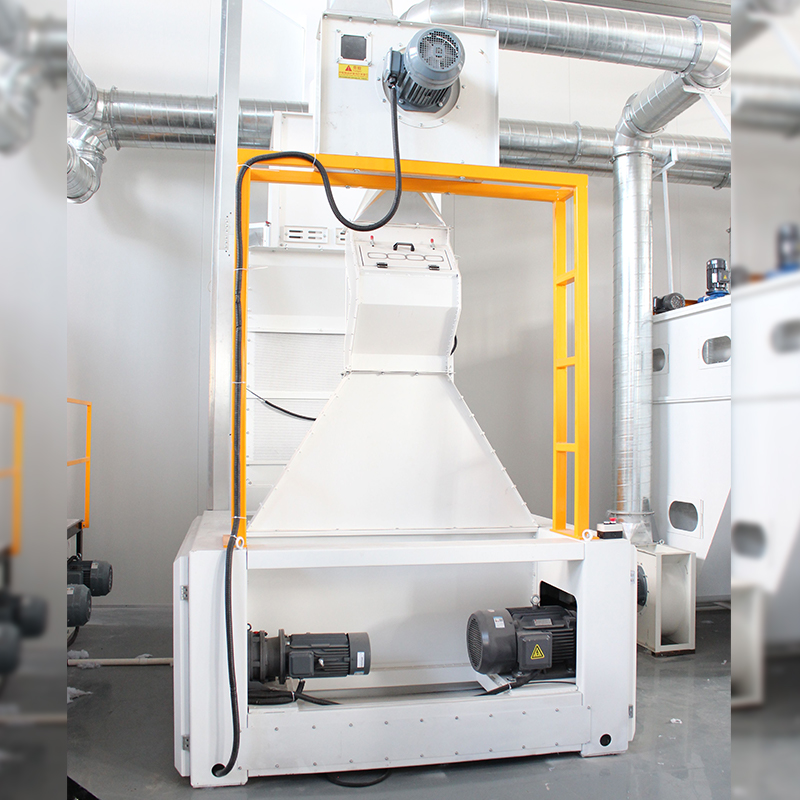 Pre & Fine Opener Machine Supplier & Wholesale | HongyiChangshu Hongyi Nonwoven Machinery Co., Ltd. is a China pre opener & fine opener machine supplier & manufacturer. Modular, CE certified, ...View Product →
The blender itself can take different forms. In needle-punched and thermal-bonded lines, a big chamber blender stores the fiber in vertical layers and withdraws it from the bottom by a spiked lattice or drum. The vertical cut averages out variations that occurred during the minutes it took to fill the chamber. This is the most reliable way to stabilize the blend when the recipe contains one dominant component.
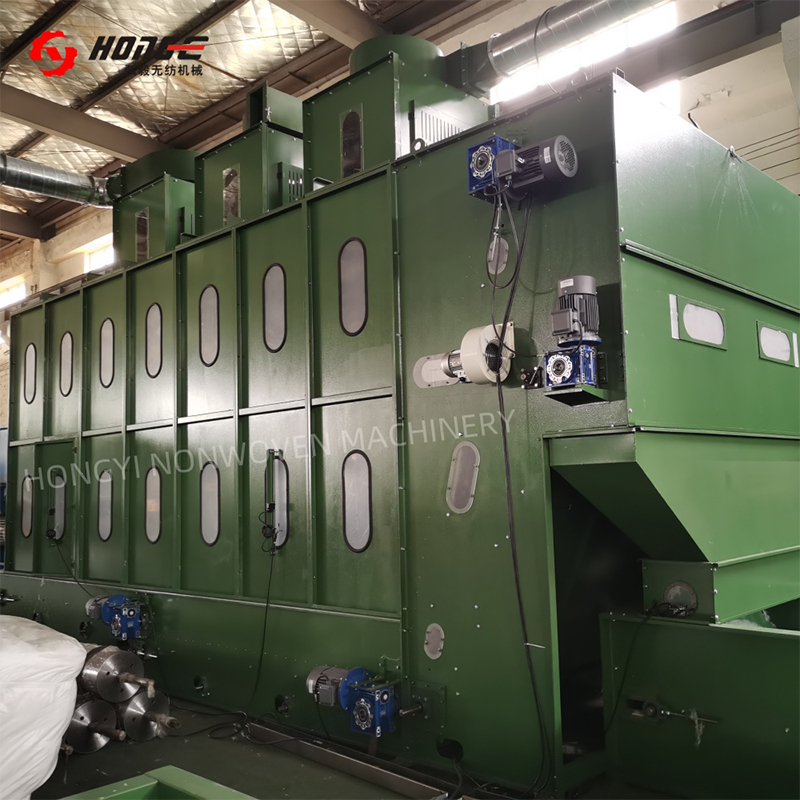 Nonwoven Big Chamber Blender Machine Supplier | HongyiChangshu Hongyi Nonwoven Machinery Co., Ltd. is a China nonwoven big chamber blender machine supplier & manufacturer. 15–37m³, CE certifi...View Product →
Can you prove the mix is good enough?
The degree of mixing is always measured by variation, not by average. A line can hit the target blend ratio over an hour and still produce bad fabric because the mix was correct on average but uneven in every two-minute window. This is why the key metric is the coefficient of variation (CV) of the blend ratio, ideally measured over short web lengths.
In practice, mills use four levels of checking:
| Method | What it measures | Typical acceptance level |
|---|---|---|
| Visual web inspection | Streaks, shade spots, clumps | No visible streaks or color aggregates under standard lighting |
| Bale laydown and weighing records | Long-term ratio accuracy | Main component within +/-1.5% of target per shift |
| Laboratory blend analysis | Actual fiber content by weight | Within +/-2% of the recipe for each component |
| On-line sensors (NIR, color) | Short-term variation across the web | CV of 3% or less over 100 m of fabric |
When you evaluate a new mixing line, ask the supplier for CV data, not just capacity figures. Also ask for a test run that simulates a realistic worst case, such as switching from a dark to a light color, because the purge behavior of the blender is as important as its steady-state accuracy. This is a common procurement trap, and it is cheaper to discover during acceptance testing than in production.
Why mixing still fails in production
Even well-designed lines lose mixing quality. Field experience in nonwoven plants points to a small set of repeatable causes. The approximate share of each cause in typical troubleshooting cases is shown below; the percentages are illustrative, based on the distribution usually seen in service records rather than on a published standard.
- Insufficient opening (35%)
- Weighing errors (25%)
- Short blending time (20%)
- Poor bale laydown (12%)
- Build-up and wear (8%)
- Insufficient opening. When bale opening or fine opening is starved at high throughput, the blender receives tufts that are too large, and no blender can make a uniform mix from uneven building blocks.
- Weighing and metering errors. Drifting scales, blocked fiber chutes, and pneumatic conveying that presses fiber against metering devices all distort the weight signal. These errors tend to be intermittent, which makes them harder to detect than a constant offset.
- Short blending time. Operators raise throughput and gradually reduce the chamber fill cycle until the product starts showing streaks. The fix is to keep the measured residence time inside the blender within the manufacturer's recommended window.
- Poor bale laydown. Natural fiber lots differ in fineness, length, and moisture; if the laydown plan does not spread those differences evenly, short-term ratio variation appears.
- Build-up and wear. Fiber accumulations in duct corners and on worn lattices eventually release as slubs, creating local clumps in the web.
What to check before you buy mixing equipment
Mixing equipment is rarely bought as a single machine; it is bought as part of a line, and the choice has to be made against the final fabric requirements. Keep these points on the checklist:
- Number of components and ratio range. A two-component line with stable ratios can use a simple chamber; a line that frequently changes recipes needs more flexible metering and faster purging.
- Fiber form. Staple length, denier, crimp, and bulk density change how tufts open and how they flow through ducts. A machine that suits a 6-denier polyester staple may behave differently with a high-loft, low-density fiber.
- Throughput. The blender volume must match line speed. Most blending chambers are designed for 10 to 30 minutes of residence; if a supplier quotes much less, ask for the expected CV at full throughput.
- Automation and data. Weighing belts, frequency drives, and PLC recipes convert a mechanical blender into a repeatable process tool.
- Cleanability. Color change time depends on smooth interior surfaces, accessible cleaning doors, and the ability to purge the chamber quickly.
For continuous mixing of two or three components, a dedicated fiber mixing machine combines a weighing or volumetric feed with active mixing elements, so the blend is homogenized as it moves toward the card. This configuration suits lines that need a stable blend in a compact footprint.
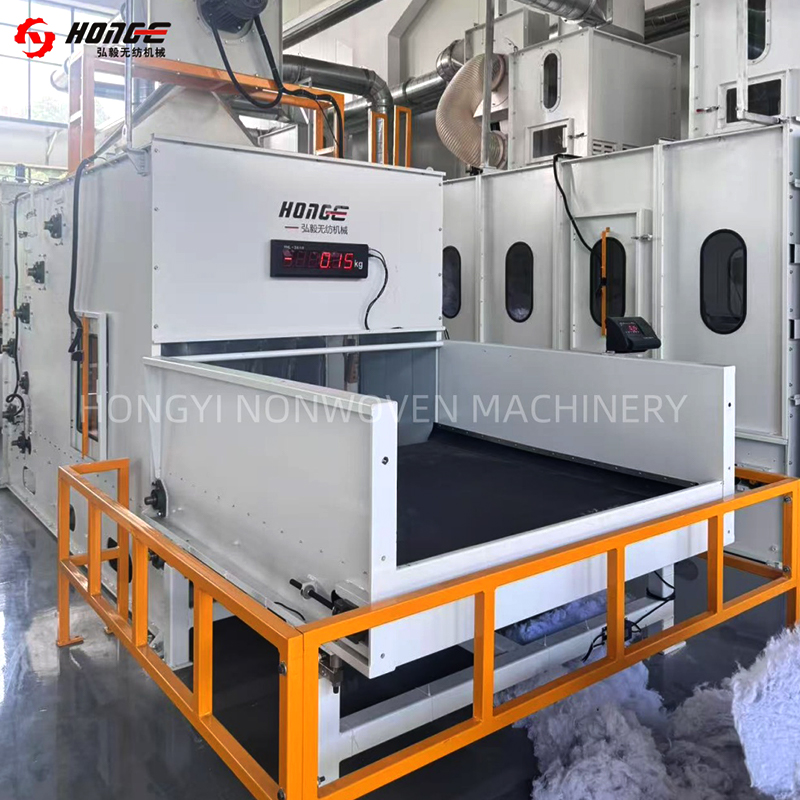 Fiber Blending Machine Supplier & Exporter | HongyiChangshu Hongyi Nonwoven Machinery Co., Ltd. is a China fiber blending machine supplier & manufacturer. Proportional weighing, CE certifi...View Product →
Beyond the machine itself, evaluate the supplier. A manufacturer with more than 20 years of nonwoven machinery experience and multiple installations abroad is more likely to support you with process recommendations, reference lines, and spare parts during commissioning. Ask for the nearest reference installation that runs a product similar to yours, and check the blend CV you can expect at full throughput.
Frequently asked questions about fiber mixing
What is the difference between a fiber mixing machine and a big chamber blender?
A big chamber blender works in a batch-like cycle: it builds vertical layers and then cuts across them, averaging variations over a period of minutes. A fiber mixing machine blends continuously in a single pass, using mixing elements or air current, and is usually placed after the weigh section. Many lines use both: one for averaging, one for final homogenization.
How much residence time in the blender is enough?
It depends on the number of components and the tolerated CV, but 10 to 30 minutes is a common design range for staple nonwoven lines. If the chamber provides less than 10 minutes at maximum throughput, test the blend CV before accepting the design.
Can recycled fibers be mixed in the same equipment?
Yes, but recycled fibers need extra opening before entering the blender because they are entangled and may contain hard particles. A pre-fine opener upstream reduces the risk of clumps and protects the metering devices. The blend ratio of recycled content should also be monitored, since its bulk density varies more than virgin fiber.
Why do streaks appear only after a color change?
Residual fiber from the previous recipe remains in ducts, chamber corners, and on lattice surfaces. During the next recipe it is released gradually and appears as streaks. Lines that switch colors frequently should be designed with smooth duct interiors, quick-purge chambers, and accessible cleaning doors.
Fiber mixing is not the most complicated part of a nonwoven line, but it is the part that determines whether the rest of the line can run at its true potential. When the next quality problem appears, check the blend first. The bale end of the line will usually tell you what the winder end is about to produce.