

Content
- 1 The Short Answer Before the Detail
- 2 What Each Process Actually Does to the Web
- 3 Fibre Selection Is the First Gate
- 4 Where the Physical Properties Diverge
- 5 Cost, Energy and Throughput
- 6 Matching the Process to the End Product
- 7 Hybrid Lines: Needle First, Then Bond
- 8 Specifying a Needle Line So It Stands Up
- 9 Frequently Asked Questions
Put two 400 gsm polyester felts side by side, one needle punched and one thermally bonded. The needle-punched sample takes a hard pull in both directions and stays thick under load. The bonded sample feels softer and lighter, but tear it across the web and it splits along a line. That single test carries most of the decision: needle punching buys mechanical strength and thickness, thermal bonding buys softness, a uniform hand and line speed. What follows is about which of those two you actually need, and what each one costs downstream.
The Short Answer Before the Detail
If the product has to survive being pulled, punctured, buried or dragged, choose needle punching. If it has to feel soft, sit flat, hold a low grammage and come off the line quickly, choose thermal bonding. If you need both, run a needle line into a heat-setting oven, which is more common than most buyers expect.
| Decision factor | Needle punching | Thermal bonding |
|---|---|---|
| Bonding mechanism | Barbed needles pass through the web and drag fibres through the thickness | Thermoplastic fibres melt in an oven and re-solidify as welds at fibre crossings |
| Fibre range | Almost any fibre that cards, including recycled and natural fibres | Needs a thermoplastic or bicomponent share, often 20 to 40 percent of the blend |
| Hand and bulk | Dense, felt-like, holds thickness under load | Soft, light, rebounds slowly |
| Tensile and tear | High, with useful strength across the width | Moderate, and a tear travels along the weak line |
| Typical grammage | Roughly 150 to 1500 gsm | Roughly 60 to 600 gsm |
| Energy profile | Electrical, concentrated in the needle drive and card | Thermal, concentrated in the oven burner bank |
| Typical end uses | Geotextiles, carpet backing, automotive trim, felts, wipes | Waddings, hygiene layers, filtration media, furniture filling |
A machine price list is a poor guide here. A bonded line often quotes lower, but it locks you into buying bicomponent fibre and into paying an oven bill for every hour the plant runs. A needle line costs more in mechanics and consumes needles, but it can run the cheap recycled fibre a bonded line has to reject.
What Each Process Actually Does to the Web
Needle punching is purely mechanical. A needle board carries thousands of triangular needles with barbs near the tip. As the web passes, the board drives down, the barbs catch fibres and drag them from the surface into the body of the web and back out again. Repeat that tens of thousands of times per square metre and the fibres interlock. Nothing melts and nothing is added.
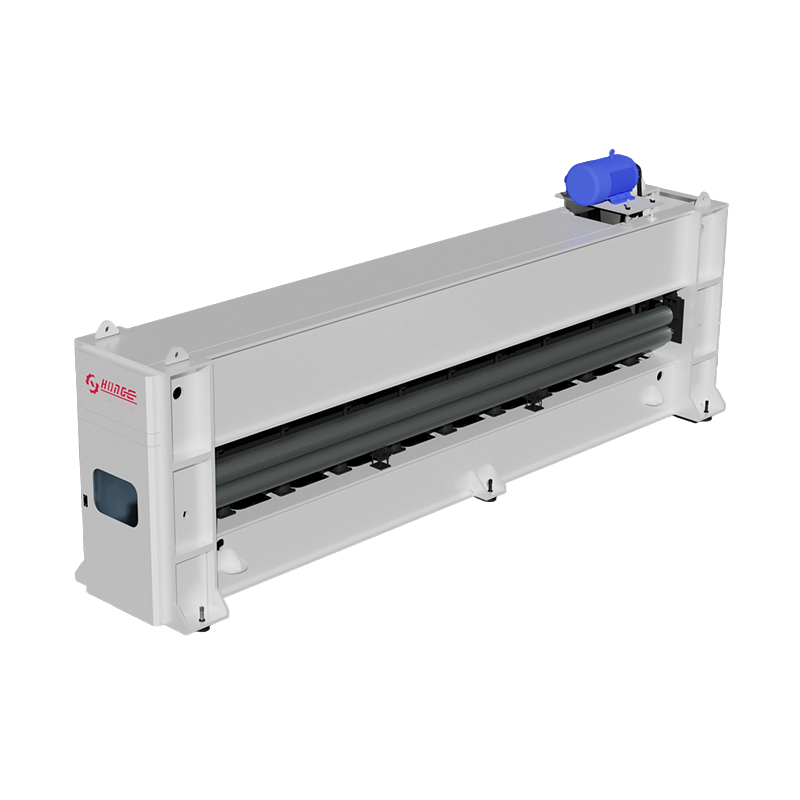
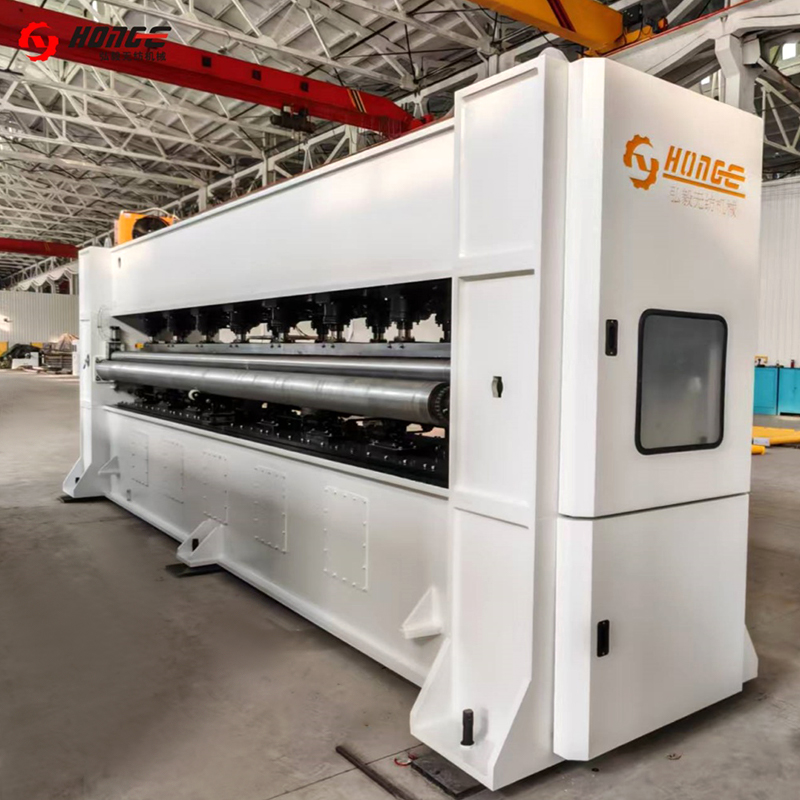 HYZC Needle Punching Machine for Nonwoven Fabric ProcessingReview this needle loom for nonwoven reinforcement and surface finishing, offering single or double boards, up to 8500 mm working width, and 800–1200 r/m needle frequency.View Product →
Thermal bonding is a heat process. The web contains low-melt binder fibre or bicomponent fibre with a low-melt sheath and a higher-melt core. Hot air is forced through the web in an oven, the sheath polymer softens, and after the web exits, the polymer re-solidifies at every crossing point. The structure is held by millions of small welds rather than by friction between fibres.
The physical consequence is fixed. Interlocked fibres resist tension; welded crossings resist only up to the strength of the weld, and once one weld fails the crack walks. That is why a bonded wadding tears cleanly while a needle felt holds together.
Fibre Selection Is the First Gate
Thermal bonding is the more demanding route because it depends on the blend. A typical recipe uses PET/PE bicomponent fibre or low-melt PET mixed with standard PET. If the thermoplastic share is too low, the web leaves the oven limp and delaminates. If the oven runs too hot, the sheath polymer shrinks the web, makes it brittle, or yellows it. Both faults show up on the line within minutes.
Needle punching tolerates almost anything a card can handle: virgin and recycled polyester, polypropylene, viscose, wool, jute, coir and post-consumer carpet waste. The blend needs no thermoplastic component at all. That is why geotextiles and automotive trim, where the raw material often includes production scrap, are still dominated by needle lines.
Web quality begins upstream of either process. An uneven feed makes an uneven batt, and an uneven batt becomes thin patches in the needle loom or hard and soft zones out of the oven. A steady vibrating feeder ahead of the card removes most of that variation before it reaches the bonding stage.
Where the Physical Properties Diverge
Four differences appear on almost every specification sheet:
- Tensile and tear strength. Interlocked fibres carry load in both directions, so a needle felt survives handling, burial and installation. Welded bonds are strong in plane but brittle at the weld point.
- Thickness and compression. Needle felt holds 5 to 10 mm of loft and recovers part of it after compression, which matters for drainage and cushioning. Bonded wadding compresses flatter and stays flatter.
- Anisotropy. A cross lapper lets you tune the machine-direction to cross-direction ratio on a needle line. A bonded line is closer to isotropic but offers less room to adjust.
- Heat ageing. A bonded web softens as it approaches the softening point of its binder and will delaminate under hot pressing or hot washing. An interlocked web has no such threshold.
If the customer judges the sample by hand alone, thermal bonding usually passes. If the sample goes into a tensile tester, needle punching usually wins.
Cost, Energy and Throughput
Buyers tend to compare the two routes on machine price, which is the least useful number. Three costs matter more:
- Fibre cost per tonne. Bicomponent and low-melt fibres carry a premium over standard polyester and lock the unit cost of every kilogram you sell.
- Energy per hour. An oven consumes gas or electricity continuously while it is hot. A needle loom consumes electricity in proportion to needle frequency and line speed.
- Consumables. Needles and needle boards are a running cost on a needle line; belts, filters and burners are the equivalent on a bonded line.
Line speed cuts the other way. A bonded line runs two to four times faster than a needle line at the same width. Above roughly 500 gsm, though, needle punching usually produces the cheaper square metre, because the oven must heat a heavier web and the fibre premium scales with weight.
Matching the Process to the End Product
Application decides the process long before price does:
- Geotextiles, drainage mats and road fabrics: needle punching, for thickness, puncture resistance and strength after installation.
- Automotive trim, wheel arch liners and boot liners: usually needle punched; bonded where a flat, soft surface is required.
- Nonwoven carpet backing and carpet underlay: needle punching.
- Felts, polishing pads and industrial wipes: needle punching.
- Waddings, quilt filling and upholstery padding: thermal bonding, which delivers softness at low grammage.
- Acquisition and cover layers in hygiene products: thermal bonding.
- Filtration media: both. Needle felt for bag filters, bonded media for pleated cartridges.
Hybrid Lines: Needle First, Then Bond
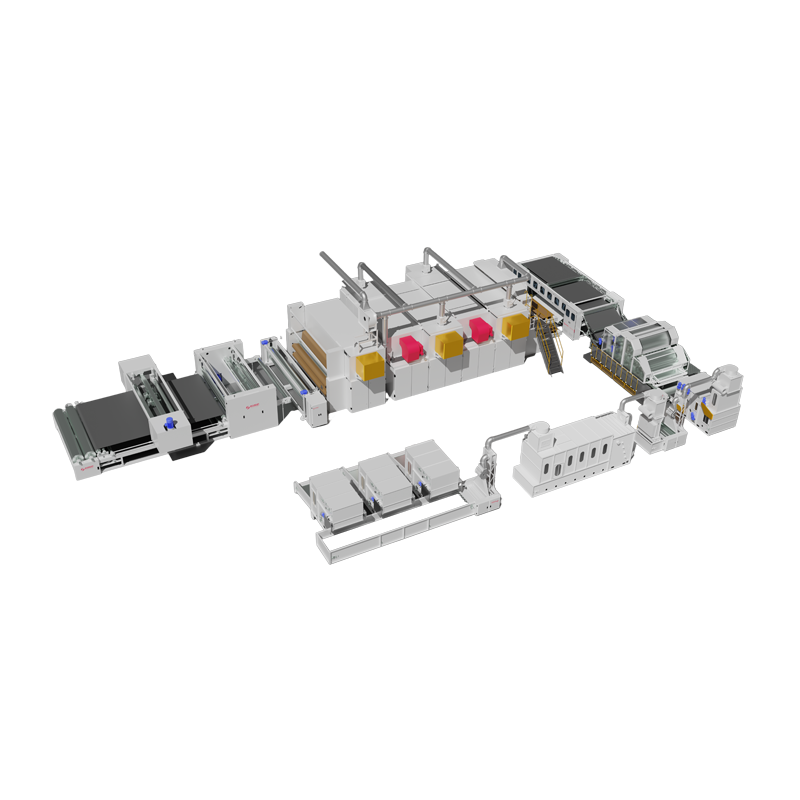
The two processes are not mutually exclusive. A needle loom can pre-consolidate the web, and the consolidated batt then passes through a heat-setting oven where binder fibre locks the structure further. The needle stage controls thickness, weight and mechanical strength; the oven controls dimensional stability, shrinkage and surface finish. Carpet underlay, automotive trim and technical felts are frequently built this way.
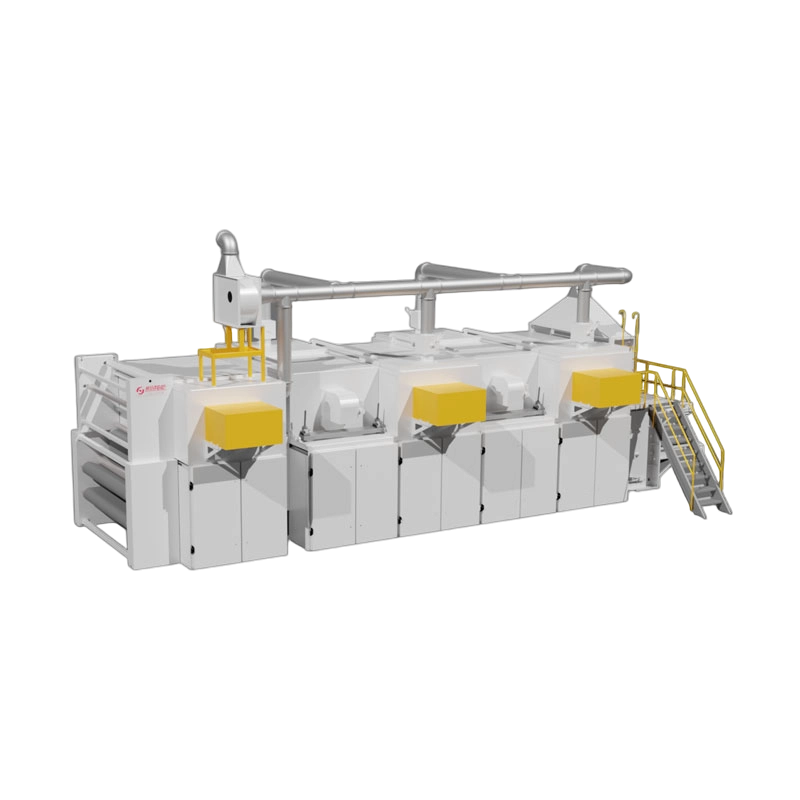
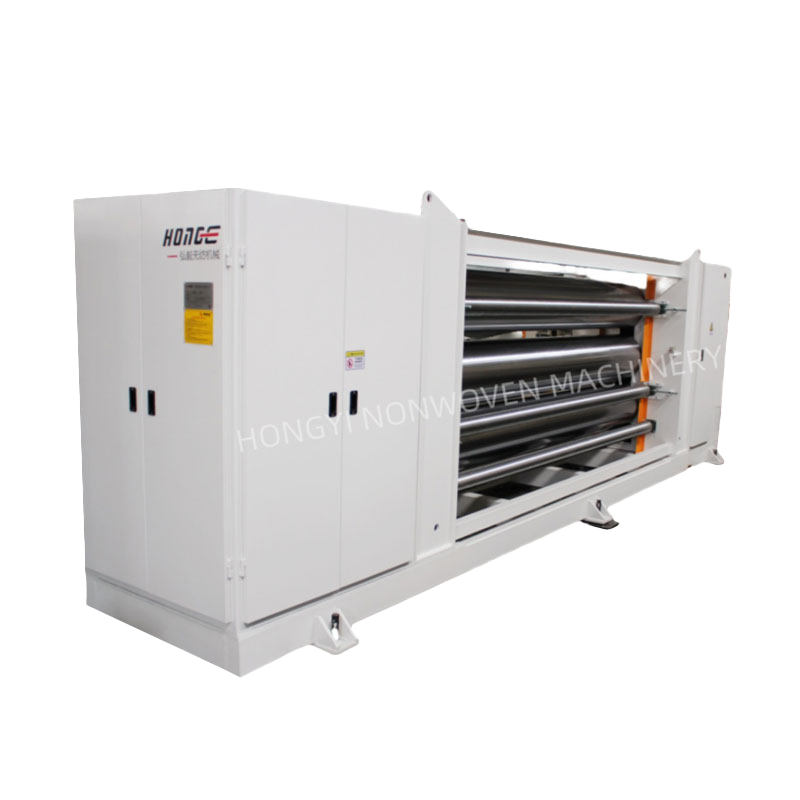
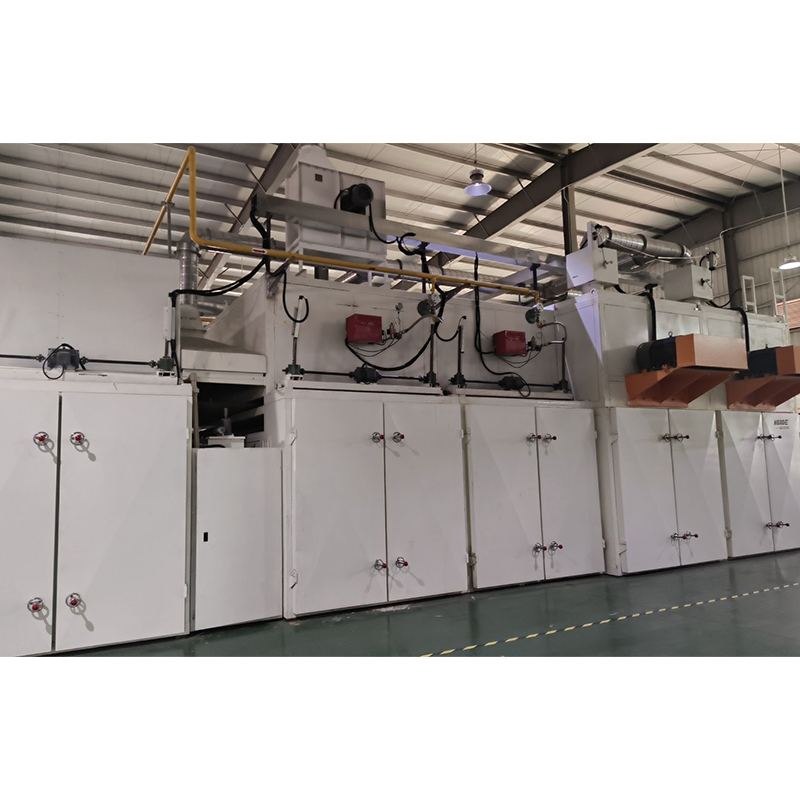 HYHX Nonwoven Fabric Thermal Bonding OvenConsider this hot-air bonding oven for low-melt fiber webs, with up to 5000 mm working width, 3–200 mm thickness, and 220°C heat-setting temperature.View Product →
On this layout the oven matters more than it does on a pure bonding line. Airflow through a pre-needled batt is uneven because the needle stage has already compressed parts of it, so the oven needs independent temperature and airflow zones across the width. A single-zone box will give you hard edges and a soft centre.
Specifying a Needle Line So It Stands Up
Four variables set the outcome of a needle felt line. Grammage and finished thickness decide the card, the cross lapper and how many needle looms run in sequence. Needle density and penetration depth decide strength and surface appearance, and they are the first settings a customer will change later. Fibre type decides whether one needle loom is enough or two are needed. Winding and slitting decide whether the rolls arrive at the customer clean, and edge trim that cannot be re-opened is simply waste.
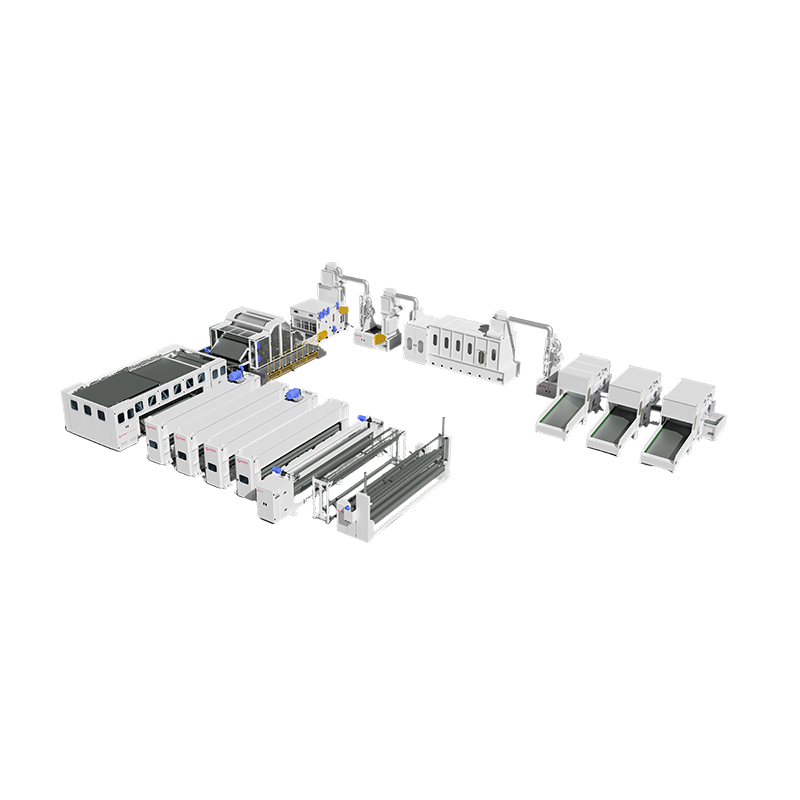
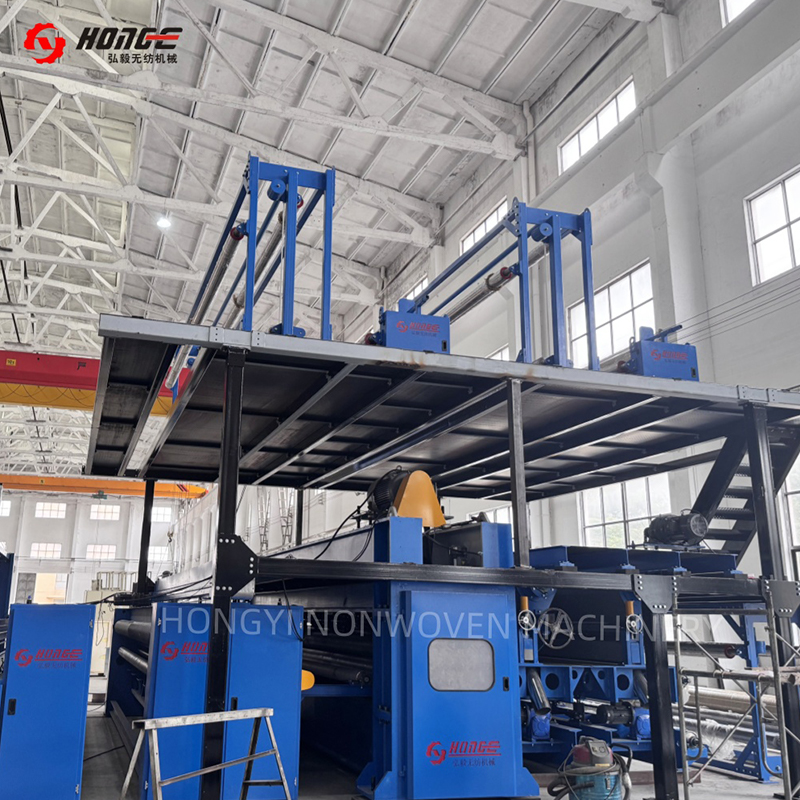 HYL Needle Punching Felt Production LineView this complete needle-punched felt line for automotive, filtration, and geotextile fabrics, with widths up to 9000 mm and 100–1500 GSM.View Product →
Changshu Hongyi Nonwoven Machinery builds both routes, from single needle looms and ovens through to complete nonwoven production lines, and has shipped to more than 20 countries including Turkey, Brazil, Vietnam and Egypt. That matters when you compare quotes, because most arguments over needle punching versus thermal bonding end as arguments about who can supply the whole line rather than a collection of machines.
Frequently Asked Questions
Can one line run both processes?
Not as one machine, but as one flow. A card, cross lapper and needle loom followed by an oven is a standard hybrid layout. A pure thermal bonding line cannot add needle punching without a needle loom in the sequence.
Is thermal bonding always cheaper to run?
Only for light products made from a blend you were going to buy anyway. Once the fibre premium, the oven energy and the higher scrap rate from temperature faults are included, the gap narrows and often reverses above 400 to 500 gsm.
Which process gives a softer nonwoven?
Thermal bonding, almost without exception. Needle punching entangles fibres, which raises density and stiffness. If softness is the specification, you are choosing bonding before you start comparing suppliers.
Can recycled fibre go into a bonded line?
Only if the recycled stream is clean and contains enough thermoplastic material. Recycled blends vary batch to batch, so oven settings have to be chased constantly. Most plants run recycled fibre on needle lines and keep bonded lines for controlled blends.
There is no universal winner. Needle punching is the right answer when the product is thick, load-bearing, made from whatever fibre you can buy cheaply, and expected to survive in the field. Thermal bonding is the right answer when the product is light, soft and uniform, and the fibre blend is under control. The expensive mistake is buying for one and specifying for the other, and that mistake shows up in the first month of production, not on the quotation.