

Content
- 1 What Thermal Bonding Means in a Nonwoven Fabric
- 2 The Three Thermal Bonding Routes on Real Lines
- 3 What Decides Bond Strength and Hand Feel
- 4 Thermal Bonding Compared With Needle Punching and Chemical Bonding
- 5 What to Check on the Machine Side
- 6 Reading Common Bonding Defects
- 7 Frequently Asked Questions
A 150 gsm polyester wadding line running at 45 m/min shows the process clearly. The web leaves the card and cross lapper looking even, passes a heated calender or a hot-air oven, and comes out as a fabric you can quilt, die-cut into an automotive panel, or pleat into a filter. Nothing was added to it: no latex, no resin bath, no needles. The strength came from the fibers themselves.
That is thermal bonding in nonwoven fabric, the process of heating a fibrous web until its thermoplastic content softens or melts and fuses where fibers cross, then cooling it so the structure sets. The same fiber blend can deliver a soft 60 gsm coverstock or a board-stiff 300 gsm panel, and in most cases the difference sits entirely in the bonding settings rather than in the raw material.
What Thermal Bonding Means in a Nonwoven Fabric
ISO 9092 and CEN EN 29092 describe a nonwoven as an engineered fibrous assembly that gains structural integrity by physical and chemical means, excluding weaving, knitting, and papermaking. Thermal bonding is one of those physical means, alongside needle punching and hydroentangling. Mechanical bonding rearranges fibers with needles, chemical bonding adds a binder, and thermal bonding uses heat to turn part of the web into its own adhesive.
Three conditions have to line up for it to work:
- A thermoplastic component in the web: polypropylene, polyester, polyamide, PLA, or a bicomponent fiber with a lower-melting sheath around a stronger core.
- Enough heat to reach the softening window of that component, which is why a PET/PE bicomponent web bonds far below the melting point of the PET core.
- Controlled time at temperature, plus nip pressure when the heat comes from calender rolls, so the polymer can flow to the contact points and set as it cools.
At fiber level the sheath melts, wets the neighboring fiber at a crossover point, forms a small meniscus, and solidifies on cooling. Bonded area is a design variable: engraved rolls typically bond 10 to 30 percent of the surface, which is what keeps point-bonded fabric flexible instead of papery.
The Three Thermal Bonding Routes on Real Lines
Calender (Point) Bonding
An engraved steel roll and a second roll form a heated nip, and only the raised points of the pattern weld the fibers. Roll surface temperatures typically fall between 130 and 160 °C for polypropylene and lower for PE-sheath webs, with nip pressures around 40 to 80 N/mm. Output is fast and machine-direction strength is good.
Flat Calender and Ironing (Heat Setting)
A smooth roll set applies heat over a much larger area, producing a denser, smoother, stiffer surface instead of discrete weld points. It suits heat-set wadding, linings, and interlinings where thickness control matters more than drape.
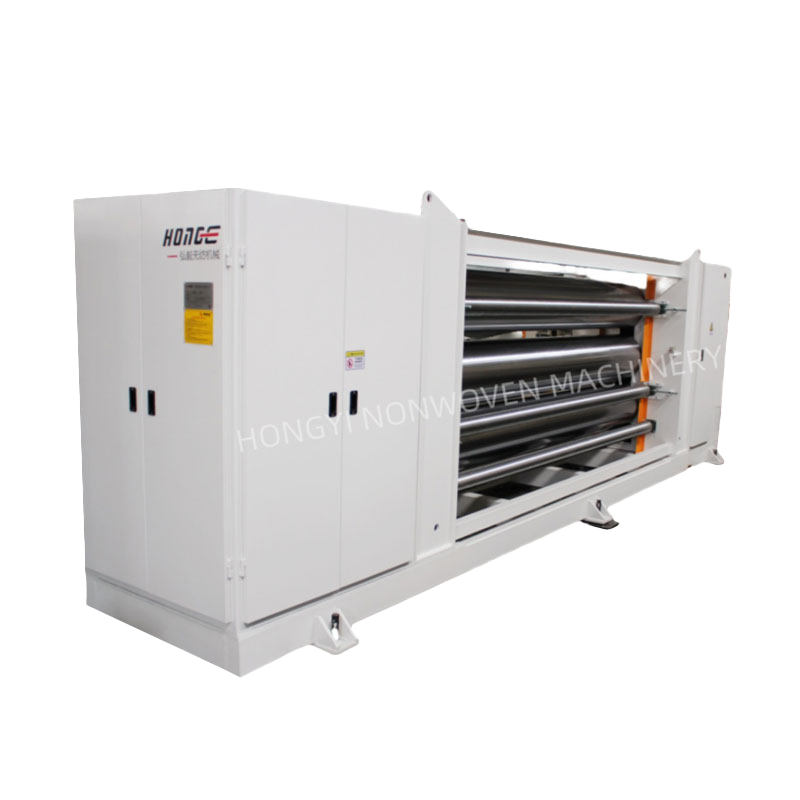
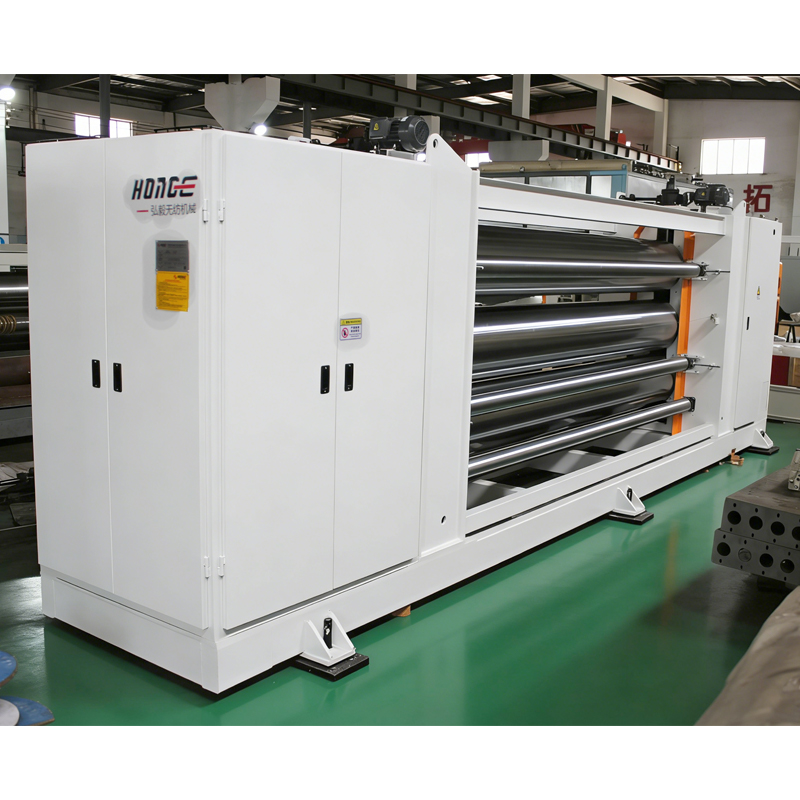 HYTG Nonwoven Fabric Ironing Machine for Surface SmoothingHeat-presses needle-punched nonwovens to smooth surfaces, improve hand feel and luster, with adjustable two-roller calendering for wadding, linings, and interlinings.View Product →
Through-Air Bonding
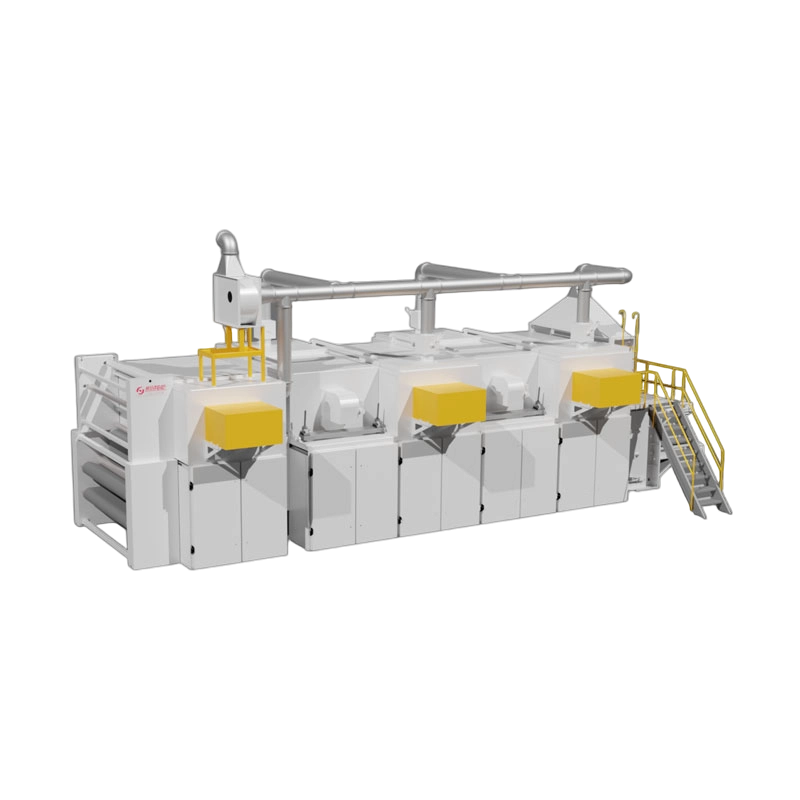
A conveyor carries the unbonded batt through a chamber where hot air is drawn through its thickness. Because heat reaches fibers in the middle of a thick web, the method suits bulky, low-density products such as wadding, insulation, hygiene topsheets, and filtration media. Air temperature, airflow uniformity, and dwell time decide quality; a 5 °C difference across the working width is enough to leave a visibly soft strip along one selvedge.
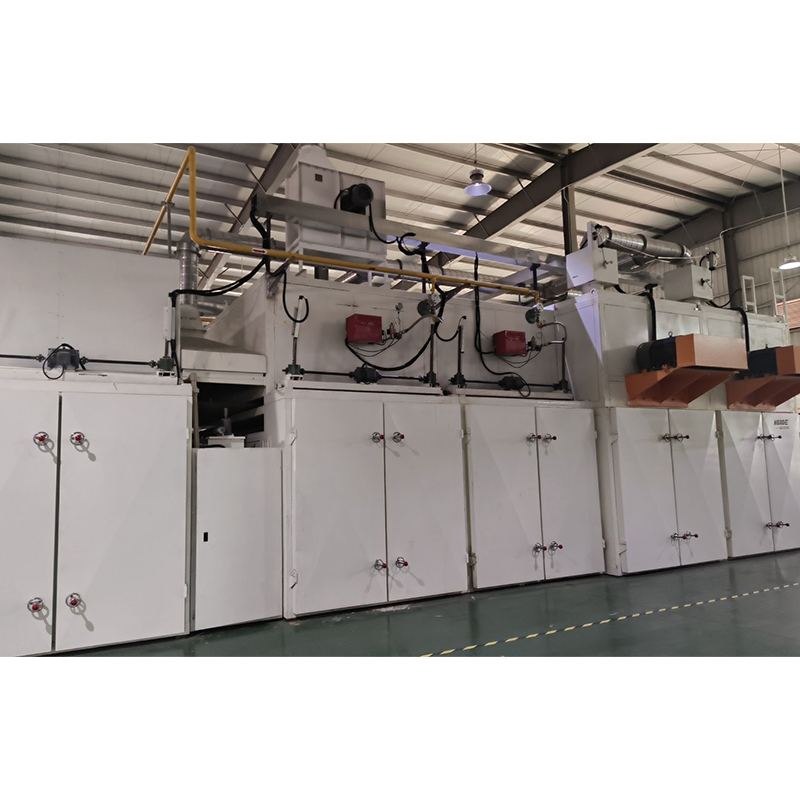 HYHX Nonwoven Fabric Thermal Bonding Oven for WaddingHot-air thermal bonding and heat-setting oven for low-melt fiber webs, producing hard or thick wadding with single- or double-belt heating and cooling.View Product →
| Method | How heat reaches the fiber | Pressure | Typical web | Typical products |
|---|---|---|---|---|
| Calender point bonding | Contact with a heated engraved roll | High nip pressure | PP, PET, bicomponent blends with 15-30% binder fiber | Hygiene topsheets, medical drapes, thin wipes |
| Flat calender or ironing | Contact with smooth heated rolls | Medium to high | PET and bicomponent blends | Heat-set wadding, interlinings, shoe materials |
| Through-air bonding | Hot air drawn through the batt | None to low | Sheath-core bicomponent, PP and PET blends | Wadding, insulation, filter media, hygiene cores |
What Decides Bond Strength and Hand Feel
The fiber blend sets the ceiling of what is possible; the machine only decides whether that ceiling is reached. Four factors do most of the work.
Fiber choice and blend ratio
A 100% polypropylene web bonds by partly melting its own surface. Blending 70-85% structural fiber with 15-30% bicomponent binder fiber usually gives a better strength-to-softness balance, because the core keeps its bulk while only the sheath takes part in bonding.
The temperature window
Every blend has a usable window, often only 10 to 20 °C wide. Below it the web is under-bonded and fuzzes or delaminates; above it the fabric turns shiny, brittle, and thin. Because the window is narrow, a few degrees of drift across the width matters more than the setpoint shown on the display.
Dwell time, pressure, and line speed
Bonding is a time-at-temperature problem. Doubling line speed halves dwell time in the nip or oven, so speed and temperature changes should be made together. Higher nip pressure increases bond area but crushes thickness, while in through-air ovens airflow uniformity does the job that pressure does in a calender.
Web uniformity before bonding
Bonding cannot repair an uneven web. Basis weight variation from carding and cross lapping becomes bond variation, because a thin spot heats faster than a thick one. A vibrating feeder that delivers a steady fiber mat often matters more to edge-to-edge consistency than another degree of oven temperature.
Thermal Bonding Compared With Needle Punching and Chemical Bonding
Thermal bonding wins when you need speed, clean processing without water or solvent drying, and a product that stays soft and drapeable. It loses when the blend contains no thermoplastic content, when very high loft at low density is required, or when the end use demands mechanical interlocking.
- Thermal bonding fits hygiene materials, wadding, filtration media, and heat-set interlinings where production speed and clean processing dominate.
- Needle punching fits geotextiles, felts, carpets, and automotive trim where thickness and toughness matter more than a smooth surface.
- Chemical bonding fits non-thermoplastic fibers such as cotton or glass, or products whose hand feel depends on a specific binder chemistry.
Many lines combine the methods, since a needle-punched or spunlaced structure can pass through an oven afterward to stabilize thickness.
What to Check on the Machine Side
When a thermal bonding line is specified or troubleshot, the bonding unit is only one link in the chain. Upstream stages decide whether the heat receives a uniform web, and downstream stages decide whether that uniformity survives to the roll.
- Opening and blending: even bale opening keeps binder fiber distribution consistent, because one stray clump becomes a hard spot after bonding.
- Feeding and carding: a steady feed mat and a correctly set card produce even fiber orientation, which becomes even bond density.
- Web forming: the cross lapper sets the MD/CD strength ratio, and the number of layers changes dwell time in the oven.
- Bonding: temperature zones, airflow, nip pressure, pattern, and cooling distance belong in a written recipe rather than in an operator's memory.
- Winding and cutting: tension control protects a web that is already set, since pulling a warm fabric distorts it permanently.
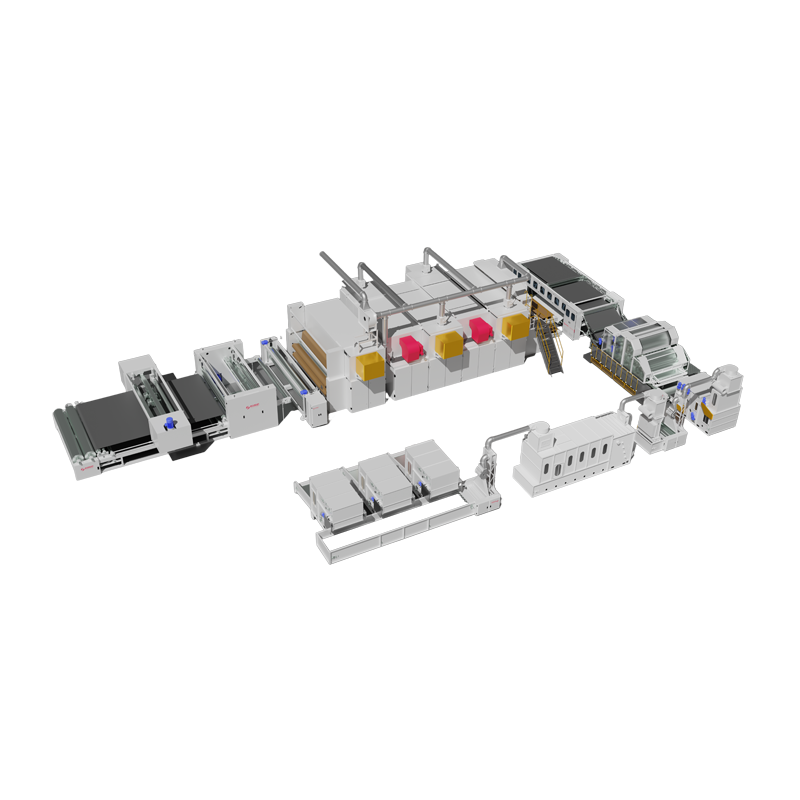
Because those settings interact, many buyers specify a complete line rather than individual machines, so oven length, airflow, cooling zone, and winder speed are matched from the start.
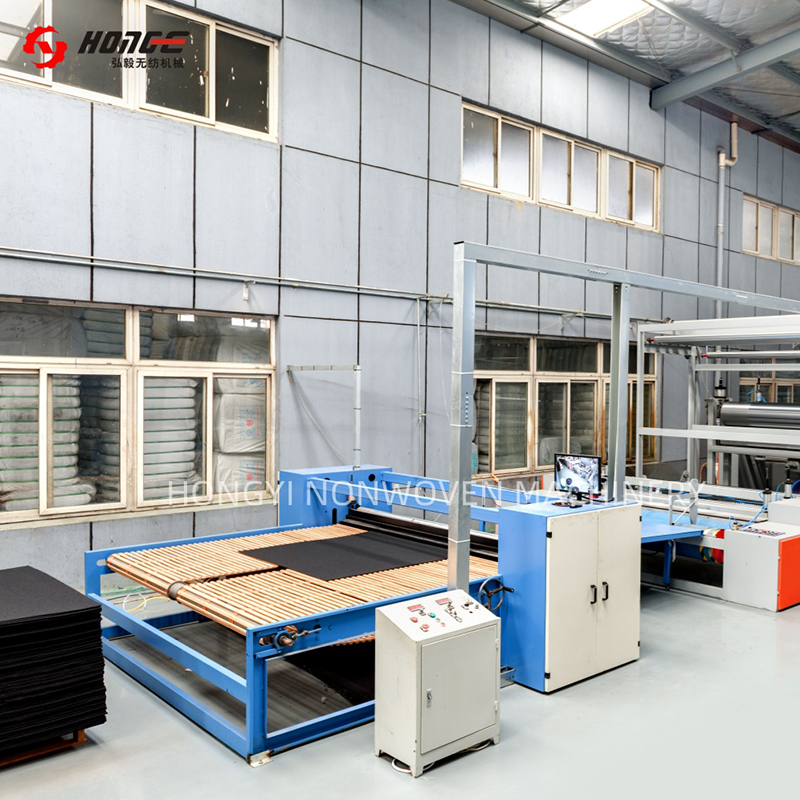 HYL Thermal Bonded Wadding Production LineComplete thermal-bonded wadding line for mattresses, cushions, medical packaging, and agricultural fabrics, with matched oven, cooling, and winder settings.View Product →
Reading Common Bonding Defects
Most bonding problems produce a recognizable signature, and the fix is rarely "raise the temperature".
- Fuzzing and fiber pull-out: under-bonded. Check binder fiber content, temperature, and line speed before touching pressure.
- Boardy, shiny, brittle fabric: over-bonded. Reduce temperature or shorten dwell, then check how much thickness was lost.
- Weak edges only: uneven temperature or airflow across the width, or edge trim pulling before the web has set.
- Repeating marks: calender pattern mismatch, roll damage, or tension flutter in the web.
- Delamination in thick wadding: heat never reached the core. Increase airflow through the batt instead of raising surface temperature.
- Shrinkage after bonding: residual stress. Reduce tension between bonding and winding, and review the cooling distance.
Frequently Asked Questions
Is through-air bonding the same as thermal bonding?
No. Through-air bonding is one method of thermal bonding, alongside calender bonding and flat-roll heat setting. The common factor is heat activating a thermoplastic component, not the way the heat is delivered.
What temperature is used for thermal bonding?
It depends on the polymer. Polypropylene calender bonding typically runs in the 130-160 °C band, PE-sheath bicomponent webs lower, and PET-based blends higher, with a usable window of roughly 10-20 °C. Confirm the range with the fiber supplier before fixing a recipe.
Can thermal bonding replace needle punching?
For thin hygiene and filtration products, often yes. For thick geotextiles, carpets, and automotive felt, usually not, because those structures depend on the loft and mechanical entanglement that needles create.
Thermal bonding is less a single machine than a set of relationships: binder content against temperature, dwell time against line speed, airflow against basis weight. Define the fiber blend, the target hand feel, and the acceptable tolerance on thickness and tensile strength first; after that, oven length, calender pattern, cooling distance, and winding tension become engineering calculations rather than trial runs.