

Content
In nonwoven or traditional textile engineering, carding equipment is not a single machine type, but a category of equipment systematically matched based on fiber characteristics, production output requirements, and web formation processes. Classified by equipment structure and functional principles, mainstream carding equipment primarily includes flat carding machines, roller carding machines, and the derivative high-speed random carding machines. For current airlaid or carded cross-lapped production lines, roller carding machines and high-speed random carding machines are the absolute mainstream choices. The direct and clear conclusion is: regardless of the type of carding equipment selected, the core objective is to use the precise speed ratios between the licker-in, cylinder, worker rollers, and doffer to separate the opened and blended fiber tufts into individual fibers, while outputting a fiber web with uniform basis weight and a controllable machine direction to cross direction strength ratio.
Roller Carding Machine: The Pillar of High Output and Fiber Adaptability
Working Mechanism and Structural Characteristics
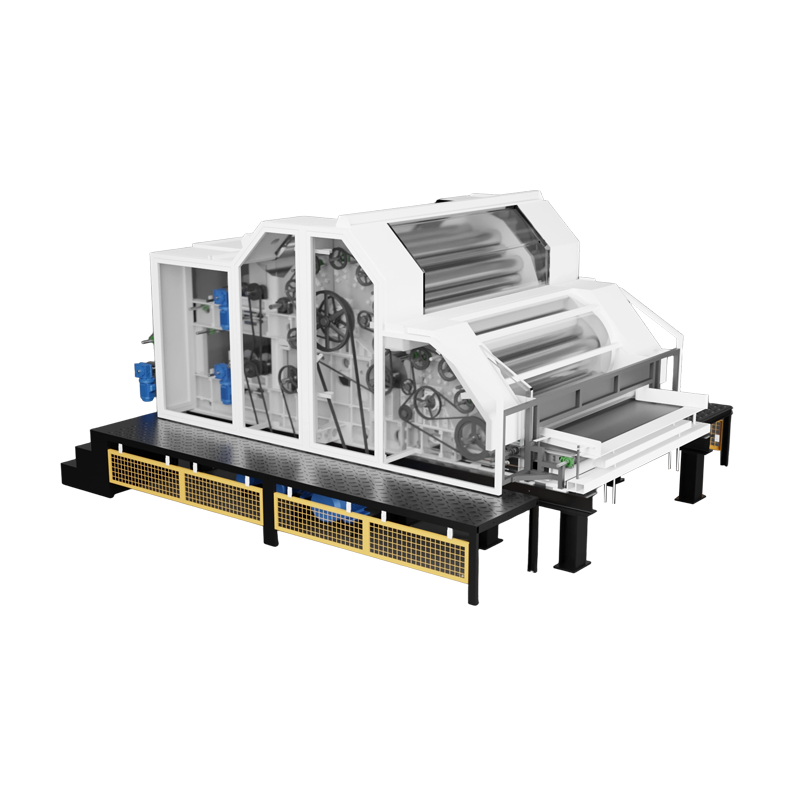
The roller carding machine is the core equipment in airlaid and through-air bonded nonwoven production lines. Its greatest structural feature is the configuration of multiple carding units composed of worker rollers and stripper rollers around the main cylinder. The fibers are repeatedly transferred and carded between the cylinder and the worker rollers. This progressive carding principle gently opens the fibers, significantly reducing fiber breakage. Typically, a wide-width roller carding machine is configured with a single or double cylinder structure. The double cylinder carding machine redistributes the fiber layer through a transfer roller between the two main cylinders, which can markedly improve the web's MD:CD strength ratio from 10:1 to 12:1 for a single cylinder to 5:1 to 8:1.
Key Process Parameters and Web Quality Control
To ensure the web basis weight variation is controlled within ±3%, the roller carding machine relies heavily on precise gauge settings and airflow control. The gauge between the main cylinder and the worker roller is typically finely adjusted within a range of 0.3 mm to 0.5 mm. An excessively large gauge results in insufficient carding, while a gauge that is too small easily damages the fibers. Furthermore, the equipment is usually equipped with high-speed cleaning rollers to remove impurities and short fibers embedded in the worker roller's card clothing, preventing the formation of carding clouds (uneven patches). In actual production, when processing 1.5 to 2.2 denier polyester staple fibers, the output speed of a roller carding machine can be stably maintained at 80 to 120 meters per minute.
Applicable Scenarios and Derivative Configurations
This equipment is widely used in the production of needle-punched padding, spray-bonded wadding, and high-weight industrial filter materials. For fibers with high crimp or those prone to static electricity, roller carding machines typically need to be configured with card clothing that has a conductive coating or be retrofitted with static elimination bars. When processing colored fibers or recycled fibers, the raw material usually contains higher levels of impurities; thus, the point density of the card clothing in the carding unit is chosen to be below 350 points per square inch to extend the clothing's service life and prevent fiber wrapping around the cylinder.
High-Speed Random Carding Machine: The Isotropic Web Formation Expert
Technical Implementation Methods of Random Carding
The high-speed random carding machine is the key equipment that enables the fiber web's MD:CD strength ratio to approach 1:1. Its technical implementation mainly relies on three mechanical methods: the first is to install a high-speed rotating random roller behind the doffer, which uses centrifugal force to alter the fiber orientation arrangement; the second uses a condensing and pushing device to mechanically compress and create a non-directional layering of fibers on the web surface; the third combines a cascade airflow, which uses vertical airflow to disrupt fiber orientation at the moment they detach from the doffer. These three methods can accurately adjust the web's MD:CD strength ratio to a range between 1.5:1 and 1.03:1.
Performance Data Comparison with Ordinary Carding Equipment
At the same basis weight, the uniformity of the web output by a high-speed random carding machine is significantly superior to that of an ordinary single cylinder carding machine. The data comparison below clearly illustrates the specific differences in various core indicators between the two:
| Comparison Indicator | Ordinary Single Cylinder Carding Machine | High-Speed Random Carding Machine |
|---|---|---|
| MD:CD Strength Ratio | 8:1 to 12:1 | 1.03:1 to 1.5:1 |
| Max Web Output Speed | 50-70 m/min | 150-200 m/min |
| Basis Weight Control Range | 100-800 gsm | 15-250 gsm |
| Fiber Damage Rate | Medium (approx. 5%) | Very Low (below 2%) |
The Sole Solution for Lightweight Nonwovens
For hygiene material coverstock or packaging fabrics with a basis weight below 30 gsm, the high-speed random carding machine is irreplaceable. Ordinary carding machines are highly prone to holes or uneven fiber deposition at low basis weights, whereas the high-speed random carding machine, through its precision feeding system and aerodynamic stripping device, guarantees that even at a high speed of 150 m/min, the coefficient of variation of a 15 gsm web remains below 4%. This type of equipment is usually configured with a suction-type forming belt tracking system to ensure that the gossamer-thin web does not drift or curl during high-speed conveying.
Flat Carding Machine: The Precision Combing Blade for Traditional Short Fibers
Doffer Comb Control and Flat Strips
Although roller carding machines dominate production lines for bulky nonwovens, the flat carding machine remains an important type of carding equipment when processing natural short fibers like cotton and flax (fiber length below 38 mm). It utilizes the extremely small gauges between the revolving flexible wire-topped flats and the cylinder's metallic wire for carding. Its most distinctive feature is the production of flat strips, an aggressive trash removal mechanism. By controlling the comb speed and flat speed, neps, leaf fragments, and seed coat fragments in the fibers can be effectively removed, with a nep removal efficiency exceeding 90%.
Comparison of Application Boundaries with Roller Carding
The carding intensity of a flat carding machine is very high, but its output is relatively limited. Its single-unit production rate typically ranges from 30 to 50 kilograms per meter of working width per hour, far lower than the 200 to 300 kilograms achieved by roller carding machines. In the nonwoven industry, if the raw material is recycled cotton short fibers or bleached cotton for producing medical absorbent cotton rolls or cosmetic cotton pads, the flat carding machine is the first choice because it imparts exceptionally high cleanliness to the product. However, once the fiber fineness is high and the length exceeds 51 mm, flat carding can easily cause significant fiber breakage and loading of the card wire gaps, at which point a roller carding machine must be used.
The Synergy of Core Components and Auxiliary Equipment Types
Card Clothing Configuration Determines the Carding Type
Regardless of the carding machine type, the detailed classification of its essence is often determined by the parameters of the metallic card clothing. The tooth profile, working angle, and point density of the card clothing directly influence the carding type:
- Diamond-like Carbon Coated Clothing: Suitable for high-tenacity synthetic fibers; its extremely low surface friction coefficient prevents lapping on the rollers caused by high temperatures generated during carding.
- Large Working Angle Clothing (65°-70°): Commonly used in geotextile production lines with high longitudinal strength requirements, enhancing fiber parallel alignment.
- Micro-tooth Double-arc Back Clothing: Specifically used in high-speed random carding machines; its small working angle and shallow tooth depth significantly reduce fiber retention, enabling web output speeds to exceed 180 m/min.
- Mixed Arrangement of Straight and Arced Teeth: In double cylinder carding machines, the first cylinder predominantly uses straight teeth for aggressive opening, while the second cylinder uses arced teeth for fine carding and transfer.
Engineering Matching of Airflow and Dust Extraction Equipment
Modern carding equipment is no longer a purely mechanical assembly but a coupled aerodynamic-mechanical system. Fly, dust, and micro-dust generated inside the carding machine are critical factors affecting web quality. Effective auxiliary equipment, such as integrated filter systems and suction trash removal ducts, directly determines whether the carding process meets the required standard. For example, a high-speed random carding machine must be configured with a web surface suction box with a negative pressure of no less than 800Pa; otherwise, the high-speed output web cannot adhere tightly to the forming belt, causing basis weight fluctuations. In roller carding machines, devices equipped with an automatic compressed air cleaning cycle have become standard. Through pulsed airflow intervention, the downtime for cleaning per ton of nonwoven fabric produced can be reduced by 65%.
- Evaluate the length, fineness, and impurity content of the fiber raw material to determine whether to use the flat or roller carding principle.
- Based on the target product's required MD:CD strength ratio, decide whether to use an ordinary physical layout or a carding machine with a randomizing module.
- Select the corresponding cylinder diameter and doffer speed ratio according to the finished product basis weight; the lower the basis weight, the higher the doffer transfer ratio should be set.
- Check the compatibility of the metallic card clothing with the pneumatic cleaning system to ensure the equipment can operate stably and continuously when processing heat-sensitive fibers.