

Content
- 1 Technical Evolution and Selection Criteria for Feeding Equipment
- 2 Technical Breakthroughs and Market Landscape of Carding Equipment
- 3 Structural Growth Opportunities in Downstream Application Markets
- 4 Comparison of Key Technical Parameters and Selection Reference
- 5 Industry Challenges and Response Strategies
- 6 Future Outlook: Dual-Drive of Intelligence and Green Manufacturing
The global carding machine market is expected to reach USD 1.4 billion in 2026 and grow to USD 1.9 billion by 2033, at a CAGR of 4.8%. Among this, nonwoven fabric manufacturing has emerged as the fastest-growing application segment, while feeding equipment—as a critical front-end process component—directly determines the quality stability of carded webs through its uniform material supply capability. The industry is currently transitioning from traditional mechanical feeding to pneumatic feeding and intelligent weighing systems, with significantly improved equipment integration and automation levels.
The Asia-Pacific region, supported by mature textile manufacturing infrastructure, commands 36% of the carding machine market share, continuing to lead global demand. Technologically, flat carding machines maintain dominance with a 65% market share, though roller carding machines demonstrate more prominent growth in synthetic fiber and technical textile applications.
Technical Evolution and Selection Criteria for Feeding Equipment
Technical Differences Between Vibrating and Pneumatic Feeders
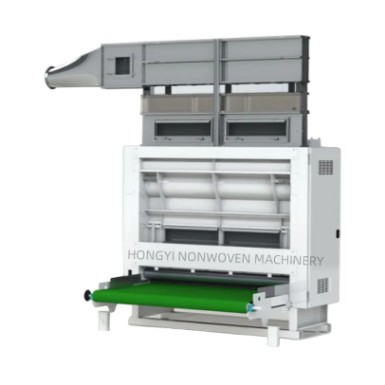
The core function of feeding equipment is to deliver opened fibers uniformly and continuously to the carding machine, ensuring consistent fiber layer thickness and density during subsequent carding processes. Current mainstream technical routes are divided into vibrating feeders and pneumatic feeders, which exhibit significant differences in applicable scenarios and technical characteristics.
Vibrating feeders utilize motor-driven eccentric shafts to generate periodic vibration, moving fibers in specific directions within the trough. Their advantages lie in simple structure and low maintenance costs, making them suitable for medium-to-low speed production lines processing natural fibers such as cotton. Taking industrial-grade vibrating feeders as an example, standard models offer processing capacities ranging from 85 to 604 tons per hour (based on material density of 1.6 g/cm³), with power coverage from 4 amps to 39 amps (at 460V), satisfying the production capacity requirements of most spinning mills.
Pneumatic feeding, conversely, employs airflow conveying principles, achieving precise control of feeding rates through air pressure regulation. This technology is particularly suitable for chemical fibers, micro-denier fibers, and nonwoven production lines requiring extremely high uniformity. The core advantage of pneumatic systems lies in instantaneous start-stop response without mechanical inertia delay, enabling accurate batch control. Meanwhile, enclosed pipeline design effectively suppresses dust dispersion, complying with increasingly stringent occupational safety and environmental regulations.
Critical Impact of Feeding Uniformity on Web Quality
Non-uniform feeding is a primary cause of grammage deviation in carded webs and uneven longitudinal/transverse tensile strength. Practical data indicates that when feeding layer density fluctuation exceeds ±3%, the CV value (coefficient of variation) of final nonwoven products rises by 15% to 20%, directly affecting the performance stability of downstream hygiene and medical materials.
To address this issue, modern feeding systems are generally equipped with weighing sensors and closed-loop control modules. High-precision weighing feeders can achieve ±0.5% or higher blending accuracy, particularly suitable for precise mixing of multi-component fibers (such as PP/PET bicomponent fibers). Additionally, for recycled fiber processing applications, feeding equipment requires extra configuration of metal detection and impurity removal devices to protect carding machine clothing from damage.
Technical Breakthroughs and Market Landscape of Carding Equipment
Application Scenario Differentiation Between Flat and Roller Carding Machines
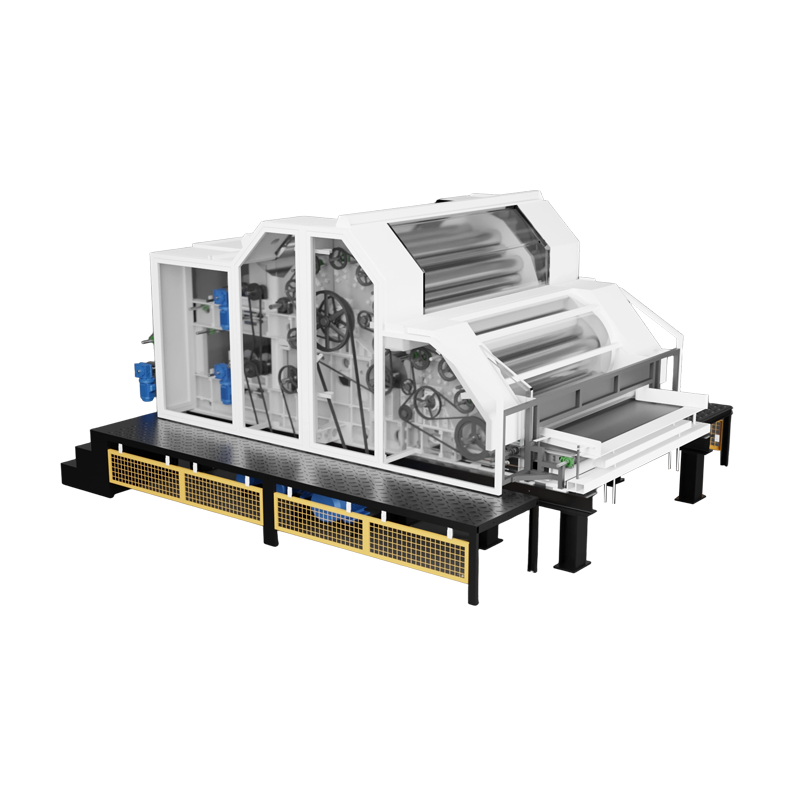
Carding machines complete fiber opening, impurity removal, and directional alignment through the interaction between cylinder, flat (or roller), and worker rollers. Flat carding machines, with their superior fiber parallelization capability, hold a 65% share of the technical market in cotton spinning. Their yarn evenness is significantly better than other models, making them suitable for denim, home textiles, and other fields with high yarn quality requirements.
Roller carding machines, due to their robust structural design and adaptability to synthetic and blended fibers, are becoming the fastest-growing technical category. In technical textiles (such as automotive interiors, filtration materials, and geotextiles), roller carding machines can process high-strength, high-modulus specialty fibers at higher output speeds, meeting the demands of large-scale industrial production.
Deep Integration of Automation and Industry 4.0 Technologies
The intelligent upgrading of carding equipment is mainly manifested in three aspects:
- Online Monitoring Systems: Through sensors deployed at critical positions such as cylinder and doffer, real-time collection of speed, vibration, and temperature data enables transparent management of equipment operating status;
- Predictive Maintenance: Based on big data algorithms analyzing clothing wear trends, early warning of replacement cycles prevents capacity losses caused by unplanned downtime;
- Auto-Leveling Technology: Automatic adjustment of feeding speed and carding parameters ensures stable定量 of output webs or slivers, reducing manual intervention.
The application of these technologies enables modern carding machines to improve production efficiency by 20% to 30% compared to traditional models, while reducing energy consumption by approximately 15%, significantly improving return on investment.
Structural Growth Opportunities in Downstream Application Markets
Nonwoven Fabric Manufacturing: The Core Engine of Demand Growth
In the carding machine application market, spinning mills currently account for 60% of the share, but nonwoven fabric manufacturing has become the fastest-growing application segment. The global technical textile production equipment market reached USD 9.6 billion in 2024 and is expected to grow to USD 17 billion by 2034 (CAGR 5.9%), with nonwoven process equipment contributing significantly.
The wide application of nonwoven fabrics in hygiene products (baby diapers, adult incontinence products), medical protection (surgical gowns, mask substrates), industrial filtration (HEPA filter media, automotive cabin filters), and geotechnical materials has driven demand for high-performance carding equipment sets. Particularly in spunbond and spunlace production lines, the uniformity of carded webs directly determines the liquid absorbency, barrier properties, and mechanical strength of final products.
Emerging Demand from Textile Recycling and Circular Economy
With policy promotion of textile circular economy in the EU and major economies, recycled fiber processing is becoming an emerging application scenario for feeding and carding equipment. Recycled fibers typically exhibit issues such as uneven length, high impurity content, and severe fiber entanglement, placing higher demands on front-end equipment.
In response to this trend, equipment manufacturers are developing carding systems with enhanced impurity removal functions, including pre-carding zone metal detection, multi-stage dust removal, and flexible clothing configuration. According to industry analysis, textile recycling applications will become an important growth pole for the carding equipment market in the next decade, providing differentiated competitive space for equipment suppliers.
Comparison of Key Technical Parameters and Selection Reference
The following table presents typical technical parameter comparisons of industrial-grade feeding and carding equipment for production line planning reference:
| Equipment Type | Applicable Fibers | Capacity Range | Feeding Accuracy | Core Advantages |
|---|---|---|---|---|
| Vibrating Feeder | Cotton, wool, natural fibers | 5–604 tons/hour | ±2%–3% | Simple structure, low maintenance cost |
| Pneumatic Feeder | Chemical fibers, micro-denier fibers | Adjustable by air pressure | ±1%–1.5% | Instant start-stop, dust controllable |
| Weighing Feeding System | Multi-component blended fibers | Continuously adjustable | ±0.5% | High-precision blending, automation integration |
| Flat Carding Machine | Cotton, cotton-type blends | High speed (by width) | Low neps, excellent evenness | High yarn quality, 65% market share |
| Roller Carding Machine | Synthetic fibers, technical fibers | Large capacity, high speed | Good web uniformity | Fastest growing, suitable for specialty fibers |
Industry Challenges and Response Strategies
High Initial Investment and Compliance Cost Pressure
The acquisition cost of advanced feeding and carding equipment is significantly higher than traditional models, posing substantial financial pressure on small and medium-sized textile enterprises. Meanwhile, the global trend toward stricter environmental regulations and occupational safety standards requires additional configuration of dust removal systems, noise reduction devices, and energy consumption monitoring modules, further raising the investment threshold.
To address this challenge, equipment suppliers are gradually promoting modular design concepts, allowing enterprises to upgrade configurations in stages according to capacity requirements and budgets. Additionally, innovations in business models such as financial leasing and production-sharing are also alleviating downstream customers' cash flow pressure to some extent.
Raw Material Fluctuations and Technical Talent Shortage
The cyclical fluctuation of fiber raw material prices directly affects textile enterprises' willingness to invest in equipment. At the same time, the insufficient supply of technical workers capable of operating and maintaining intelligent carding equipment has become a bottleneck restricting the release of advanced production capacity.
Addressing the talent gap, leading equipment manufacturers have established comprehensive training systems and are reducing reliance on on-site technical personnel through remote diagnostics and AR-assisted maintenance technologies. Some high-end models have achieved one-button batch change and automatic calibration functions, significantly shortening the learning curve for operators.
Future Outlook: Dual-Drive of Intelligence and Green Manufacturing
Looking ahead five years, the feeding and carding equipment industry will present two clear trends:
- Full-Process Digitization: Feeding and carding equipment will achieve data interconnection with downstream web laying and bonding equipment, building full-chain quality traceability systems from raw material input to finished product output;
- Sustainable Process Innovation: Low-energy drive technology, recycled fiber-specific carding processes, and waterless or low-water pre-treatment solutions will become R&D priorities, helping the textile industry achieve carbon neutrality goals.
For equipment purchasers, priority should be given to equipment openness and scalability during selection, ensuring existing production lines can smoothly access future factory-level MES (Manufacturing Execution System) and ERP platforms. Meanwhile, attention to suppliers' technical accumulation in recycled fiber processing will reserve ample space for responding to future raw material structure changes.