

Content
Fiber opening and blending equipment represents the core machinery combination located at the raw material preparation stage of nonwoven fabric production lines. Its primary functions are to loosen compressed fiber bales into loose fiber bundles, uniformly blend multiple fiber types at precise ratios, and simultaneously remove impurities and metallic foreign objects, thereby providing consistently high-quality fiber raw materials for subsequent carding and web-forming processes. This stage directly determines the uniformity, strength, and surface quality of the final nonwoven product, serving as the irreplaceable "first quality checkpoint" throughout the entire production workflow.
Equipment Composition and Classification
Fiber opening and blending equipment is not a single machine but a system composed of multiple functional units. Depending on the specific process requirements of different nonwoven production lines, the system primarily includes the following core machines:
Bale Opener
The bale opener serves as the starting point of the entire fiber preparation system, responsible for the initial dismantling and pre-opening of compressed fiber bales. Modern bale openers are generally equipped with automatic weighing systems to enable precise batching.
Taking the automatic weighing bale opener as an example, its workflow is as follows: fiber bales are placed onto a horizontal conveyor lattice, transported via an inclined top lattice, loosened by a beater, and then dropped into a weighing head. Under PLC control, precise batching is performed according to preset weights before entering the next process. When multiple bale openers are used in combination, different fibers can be automatically blended at set ratios (such as 50% polyester and 50% viscose), with blending accuracy deviation controlled within ±1%.
| Parameter | Typical Specification Range |
|---|---|
| Working Width | 1200mm - 2200mm |
| Capacity | ≤250kg/h to ≤500kg/h (single unit) |
| Feed Motor Power | 1.5kW |
| Opening Roller Motor Power | 5.5kW / 7.5kW / 11kW |
| Fan Motor Power | 4kW / 7.5kW |
| Applicable Fibers | Polyester, viscose, cotton, coconut fiber, etc. |
Fiber Opening Machine
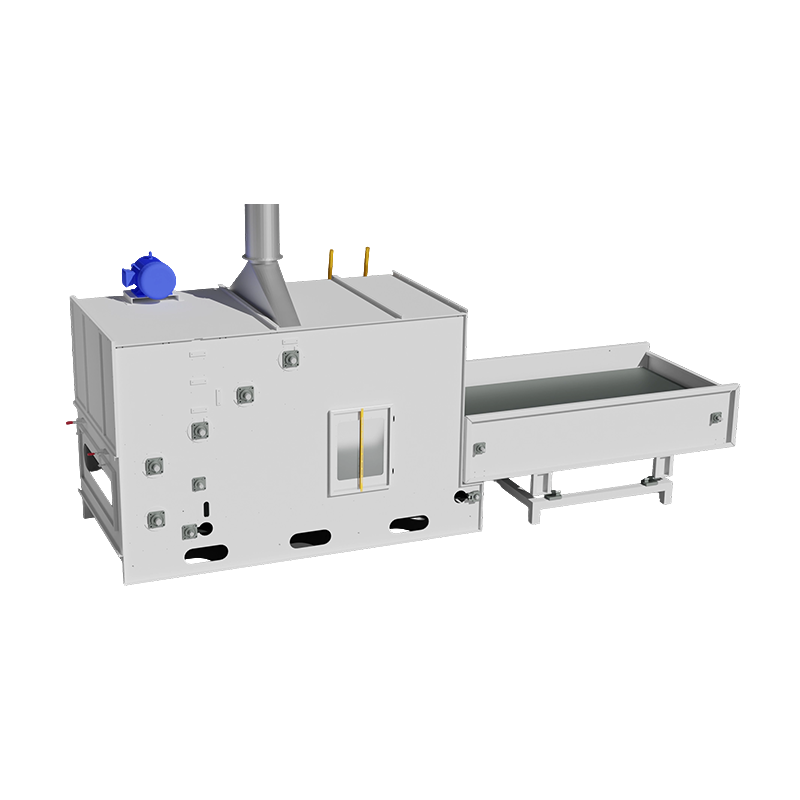
The fiber opening machine is the core equipment of the fiber opening system, divided into two stages: coarse opener and fine opener.
Coarse Opener: Its function is to further blend fiber raw materials and perform gentle opening, breaking large fiber bundles into smaller ones. Its capacity can reach 2000kg/h, with a typical working width of 1.0 meter, suitable for preliminary processing of various fiber types.
Fine Opener: This machine uses spike rollers or needle boards to deeply open fibers, breaking fiber bundles down to near-single-fiber state. Fine opening capacity is typically around 1000kg/h, with a working width of 1.0 meter. Post-fine-opening fibers are more conducive to forming uniform webs in subsequent carding processes.
The core working principles of opening machines are based on two mechanical actions:
- Tearing Action: Two machine components with spike or needle surfaces move relative to each other to tear apart fiber lumps
- Beating Action: High-speed rotating beaters (with adjustable speed) strike the fibers, divided into two forms: held beating (intense action, effective opening) and free beating (gentle action, minimal fiber damage)
Blending Equipment
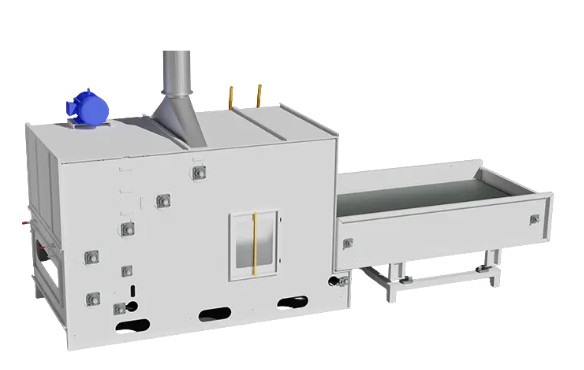
Blending equipment ensures that different fiber types are uniformly distributed, which is critical for maintaining product composition consistency. The industry commonly uses two main types of blending equipment:
Large Bin Blender: Adopts the "laying and taking" blending principle, featuring simple structure and easy cleaning and maintenance. Suitable for blending chemical fibers such as polyester and viscose, with single-unit capacity reaching 3000kg/h.
Multi-Chamber Blender: Adopts the "chamber-by-chamber feeding, simultaneous output" blending principle. Though more complex in structure, it delivers superior blending results. Through a three-point uniform blending process (90° flip blending, random grab blending by spike lattice, and thorough blending by evener roller), it ensures long-term stability of raw material quality and composition. It is particularly suitable for scenarios requiring high blending uniformity, such as pure cotton fiber processing.
Position and Role in Nonwoven Production Lines
Fiber opening and blending equipment is positioned at the very front end of the nonwoven production process. A typical process flow configuration is as follows:
Fiber Bale → Bale Opener (Grabbing/Weighing) → Pre-Opening → Blending Equipment (Large Bin/Multi-Chamber Blender) → Fine Opening → Feed Hopper → Carding Machine → Subsequent Forming Processes
Taking the cross-laid spunlace production line as an example, the configuration of the fiber preparation stage directly affects the final product quality. The process must ensure that after thorough impurity removal, blending, and opening, fibers are fed to the carding machine uniformly and continuously at the required weight under the control of continuous feeding and self-leveling devices.
Critical Quality Control Stage
The impact of fiber opening and blending equipment on product quality manifests across multiple dimensions:
- Web Uniformity: Poorly blended fibers will cause clouding, uneven thickness, and other defects in the carded web, ultimately affecting the basis weight consistency of the nonwoven fabric
- Fiber Damage Level: Excessive opening causes fiber breakage and length reduction, decreasing the final product's strength and hand feel; insufficient opening leaves fiber bundles in the web, creating defects
- Impurity Removal Rate: The strong magnets, grid bars, and suction fans equipped on the equipment remove metallic impurities and fine dust, with the removal rate directly impacting product safety and appearance quality
- Ratio Accuracy: For multi-fiber blended products (such as polyester/viscose blends), ratio deviations can cause uneven dyeing and performance fluctuations
Technical Parameters and Selection Guidelines
When selecting fiber opening and blending equipment, enterprises must comprehensively consider the following technical parameters:
| Consideration Factor | Selection Recommendation | Typical Data Reference |
|---|---|---|
| Fiber Type | Synthetic fibers (polyester, polypropylene) can use simple pre-opening; natural fibers (cotton, hemp) require intensive opening and impurity removal | Pre-opening can be omitted for synthetic fibers; natural fibers require dedicated opening-cleaning modules |
| Capacity Requirement | Match the entire production line speed with 10%-15% margin | Spunlace line: 3,500-11,000 tons/year; Needle-punching line: up to 4,500 tons/year |
| Working Width | Match downstream carding machine width; common specifications include 1.2m, 1.55m, 2.5m | Carding machine width typically 2.5m-3.8m |
| Blending Accuracy | Products with strict blending ratio requirements (such as 98%/2% extreme ratios) require high-precision weighing systems | High-precision system deviation <±1% |
| Fiber Length Adaptation | Equipment must accommodate the raw material fiber length range | Standard fibers: 12-60mm; Extra-long fibers up to 100mm |
Industry Development Trends
Automation and Intelligent Upgrades
Modern fiber opening and blending equipment is evolving toward highly automated operation. New-generation bale openers feature larger vibration-free weighing hoppers and shorter weighing cycles, with hopper capacity increased by 50% compared to traditional designs. Three-point suspension technology prevents vibration from affecting weighing accuracy. PLC control systems enable multi-machine linkage and automatic ratio adjustment, significantly reducing manual intervention.
Modularity and Flexible Production
Equipment manufacturers are increasingly adopting modular design concepts. For example, a blending metering system can be composed of 8 independent blending modules, each containing a patented blending metering system, capable of simultaneously producing four different ratios and supplying raw materials to multiple production lines. This design enables enterprises to rapidly respond to market demand changes and flexibly adjust product formulations.
Energy-Saving and Eco-Friendly Design
New-generation equipment continues to optimize energy consumption reduction. For instance, fine openers adopt variable frequency speed control technology, automatically adjusting beater speed according to fiber type and output requirements; conveying pipelines use smooth, enclosed PVC material to reduce air resistance and air leakage losses; dust removal systems integrate mesh filtration systems to enable recycling of fine dust and short fibers.
Conclusion
As the first process step in nonwoven fabric production, fiber opening and blending equipment is often underestimated in importance. In reality, quality defects at the raw material preparation stage will be amplified in subsequent processes and are difficult to remedy through later工艺 adjustments. Investing in high-performance opening and blending equipment and establishing scientific process parameter systems are fundamental guarantees for ensuring stable nonwoven product quality, reducing raw material waste, and improving production efficiency. For enterprises planning to enter the nonwoven sector, thoroughly understanding the working principles and selection essentials of fiber opening and blending equipment is a prerequisite for making correct equipment investment decisions.